
Last updated
By Ron McMinn, Esq. | Last updated: November 12, 2026.
Read this article in Español.
When a driver travels the wrong way on a California freeway, injured people and families often ask who pays. A wrong-way driver can be responsible for the harm that driving causes. Other insurers may also be involved, including a commercial policy if a big rig was part of the crash, and a household’s uninsured or underinsured motorist coverage. In the early hours of Thursday, November 12, 2026, the California Highway Patrol reported a crash involving a wrong-way driver on the westbound 91 Freeway in Riverside. Three people were killed, and a fourth person was taken to a hospital. This article looks at that crash. It does not decide who was at fault, and it does not name anyone involved. Our general guide on who pays after a crash with a wrong-way driver in California explains the broader rules.
What has been reported about the westbound 91 Freeway crash in Riverside?
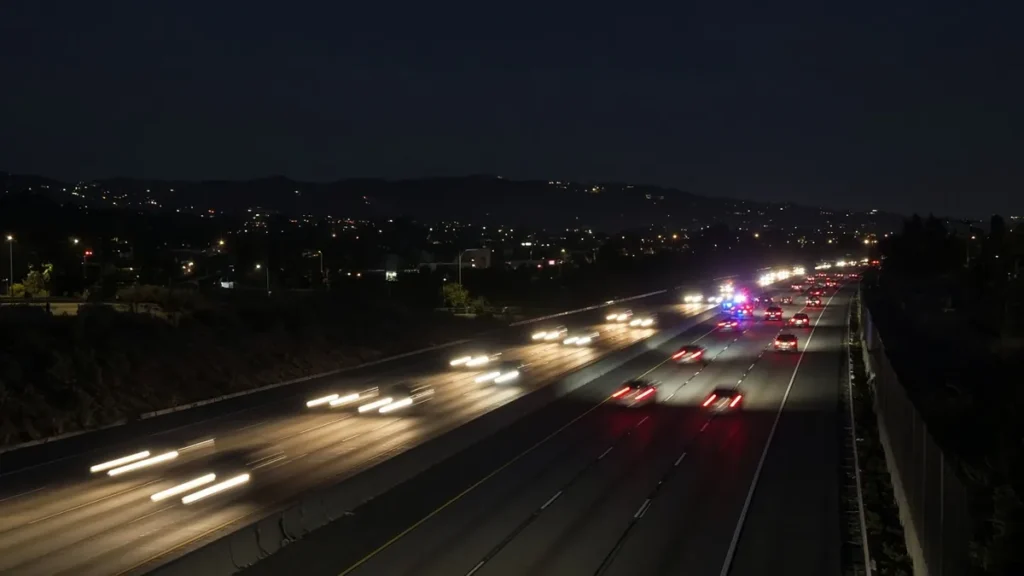
ABC7, citing the California Highway Patrol, reported that the crash unfolded around 2 a.m. near 14th Street. The CHP said a driver was going eastbound in the westbound lanes just before the crash happened. Three vehicles were involved: a white SUV, a black BMW, and a big rig. ABC7 reported that it was unclear which of those vehicles was going the wrong way. A witness reported seeing a driver speeding and swerving into lanes while going in the wrong direction on the freeway before the collision. Officers arrived to find lifeless bodies inside at least one of the cars. A fourth person was taken to the hospital in unknown condition. Several westbound lanes were closed, as was the on-ramp at 14th Street. ABC7 reported that the incident remains under investigation.
CBS Los Angeles, also citing the CHP, reported a triple-fatal crash on the westbound 91 Freeway and a Sig Alert for the freeway east of 14th Street, with only the HOV lane open and the 14th Street on-ramp closed. CBS reported that the CHP said three people are dead after a wrong-way driver crashed into a semi-truck and other vehicles.
The Whittier Daily News, in a City News Service report, said that at about 2 a.m. witnesses reported a speeding vehicle eastbound in westbound lanes east of University Avenue, according to the CHP, and that a witness then reported a black sedan, a big rig, and an SUV in a collision east of 14th Street. A CHP dispatcher confirmed that three people died at the scene. A news videographer at the scene said a fourth person was taken to a hospital by ambulance with unknown injuries.
A CHP incident log republished on chpfatal.com records a three-vehicle collision on westbound State Route 91 east of 14th Street beginning about 2:01 a.m. Early entries describe a vehicle at high speeds eastbound in the westbound lanes, swerving between cars, and a white SUV on its side, a big rig, and a black sedan. Those entries are preliminary dispatch notes, not a finding of fault, and they do not identify which vehicle was traveling the wrong way.
We are not naming anyone who was hurt or killed. These are attributed reports, not findings by this firm. They do not establish fault, speed, or the sequence of impacts. Public reporting has not said whether alcohol or drugs were involved, and this article does not assume that they were.
Who may be responsible after a wrong-way freeway crash?
A driver who travels the wrong way on a divided highway can be responsible for the harm that driving causes. Vehicle Code section 21651 makes it unlawful to drive on a highway except to the right of a dividing section that separates opposing lanes, and a willful violation that results in injury or death can carry more serious criminal penalties. A civil claim still depends on the evidence: who was traveling in the wrong direction, how the vehicles came together, and whether more than one driver shares fault. ABC7 reported that it was not yet clear which of the three vehicles was going the wrong way. That question should be answered from the CHP investigation, not from early news accounts.
Our article on who pays after a crash with a wrong-way driver in California explains those rules in general terms, including claims against a vehicle’s owner and, in some situations, an employer. This piece applies them to the Riverside crash reported on November 12.
Liability insurance for an at-fault driver is often the first place a claim looks. Under Civil Code section 1714, everyone is responsible for harm caused by a lack of ordinary care. If the evidence shows that more than one driver failed to use that care, more than one policy may be in play.
A passenger is rarely the person who caused the crash. Depending on the evidence, a passenger may have a claim against one driver or against more than one, and may also look to household uninsured and underinsured motorist coverage. An injured driver can still have a claim even if that driver shares some fault. California’s comparative fault rules, discussed below, can reduce the recovery. They do not automatically erase it.
California uses comparative fault. In Li v. Yellow Cab Co. (1975) 13 Cal.3d 804, the California Supreme Court replaced the old all or nothing rule with a system that divides responsibility by percentage. If an injured person shares fault, a claim can be reduced, but it is not erased. Under Civil Code section 1431.2, each responsible person can be liable for the full amount of economic losses, such as medical bills and lost income, while non-economic losses, such as pain and suffering, are generally divided by each person’s share of fault.
Does a big rig change who may pay?
Reporting on this crash agrees that a big rig, also described as a semi-truck, was one of the three vehicles involved. That fact alone does not decide who was at fault. If the evidence later shows that a commercial driver or a motor carrier shares responsibility, a commercial auto liability policy, and in some cases the carrier itself, may be part of the claim. Commercial limits are often higher than a private auto policy, but the limits do not create liability. If the evidence shows that the truck was traveling lawfully and was struck by a wrong-way driver, the truck’s insurer is not automatically the one that pays.
Our article on who pays after a big rig crash on a California highway and our truck accidents page explain those insurance layers in general terms.
What if a later investigation raises a question of impaired driving?
Public reporting on this crash, including the ABC7 and CBS Los Angeles accounts and the CHP incident log described above, has not said that any driver was under the influence of alcohol or drugs. This article does not suggest that anyone was. If a later investigation or the finished CHP report were to show that a driver was impaired, that evidence can matter in a civil claim, and in some cases a claim for punitive damages may also be examined. Those are general California rules. They are not a statement about this crash.
What claims may a family have after a death?
When a crash causes a death, Code of Civil Procedure section 377.60 allows certain family members to bring a wrongful death claim. In general terms, that group can include a surviving spouse or domestic partner and children, and in some situations other people who depended on the person who died. The statute, not a news report, decides who qualifies. A wrongful death claim covers the family’s own losses, such as lost financial support and the loss of love, companionship, and guidance.
A separate survival claim, brought through the estate under Code of Civil Procedure section 377.30, covers certain losses the person suffered before death. Section 377.34 limits what that claim can recover. Both kinds of claim still depend on evidence of fault.
Many California injury and wrongful death lawsuits must be filed within two years under Code of Civil Procedure section 335.1. If a person who may share fault also died, Code of Civil Procedure section 366.2 can require that a claim be started within one year after that person’s death. Public reporting has not said who died in this crash, or whether a driver who may share fault was among them. Families should not assume they have two years if that shorter deadline could apply. Our page on wrongful death and catastrophic injury claims explains those family claims in general terms.
Household uninsured and underinsured motorist coverage, often called UM and UIM, can also matter when a responsible driver has no insurance, not enough insurance, or cannot be identified. Policy definitions and notice rules matter. Our page on UM and UIM claims explains those layers.
What role does the CHP report play, and do government-claim deadlines apply?
The CHP collision report is often an important piece of evidence. It can identify the vehicles, record the officers’ observations, and give a preliminary description of what happened. It is not the last word, and early dispatch logs are not the same as the finished report. Injured people and families should ask the CHP for the report number and request the report when it is ready. It can take time.
The 91 Freeway is a state highway, generally maintained by Caltrans. A crash on that highway does not, by itself, show that the road was dangerous or that a public entity is responsible. A claim against a public entity depends on evidence that a condition of public property played a role in causing the crash. Nothing in the reporting on this crash suggests that the road was a cause, and this article does not suggest it. If evidence later points that way, Government Code section 911.2 generally requires a written government claim within six months for injury or death. That deadline is much shorter than the usual two-year period. Our guide on how to file a claim against Caltrans explains that process for the cases where it actually applies. Insurance policies can also have their own notice and arbitration requirements, including for UM and UIM claims.
What should injured people and families do now?
Medical care comes first. After that, a few steps protect a claim while a multi-vehicle investigation is still open:
- Ask the CHP for the collision report number and keep it with the hospital paperwork.
- Find every auto policy that may apply: the policy on the car you were in, the policies of the other vehicles, including any commercial policy on a truck, and every policy in your own household.
- Keep photographs already taken, medical records, discharge papers, and receipts.
- Write down the other vehicles you remember, including colors, types, and any license plates, and the names of witnesses if you have them.
- Ask early about vehicle data and about camera footage from the freeway, nearby ramps, or other cars, before vehicles are salvaged or footage is overwritten.
- Do not give a recorded statement to an insurer for another driver before you understand your rights.
- Do not post medical details or guesses about fault on social media.
We help people in Riverside and throughout California. Our Riverside injury page explains how we work with clients in the area. We work statewide from our Tustin office. We do not have a Riverside office.
Talk to us
If you were hurt, or if you lost a family member, in a California wrong-way or multi-vehicle freeway crash, Win Attorneys handles motor vehicle, wrongful death, truck, and UM and UIM matters statewide from our Tustin office. We speak Spanish and Vietnamese. We do not claim to represent anyone involved in the Riverside crash described above. That Riverside wrong-way crash is a different incident from the November 13 rain pileups on the 91 Freeway in Yorba Linda.
Call us at (657) 235-8097, reach us through our contact page, or start online with our intake form. Office: 17291 Irvine Blvd., Suite 210, Tustin, CA 92780.
This article is general information and is not legal advice. Reading it does not create an attorney-client relationship. News accounts of this crash were preliminary as of November 12, 2026. Public reporting had not established which vehicle was going the wrong way, and it had not said that alcohol or drugs were involved.
Sources
- ABC7, “3 killed in crash involving wrong-way driver on 91 Freeway in Riverside,” November 12, 2026.
- CBS Los Angeles, “Several lanes of the westbound 91 Freeway closed in Riverside after triple fatal crash,” November 12, 2026.
- Whittier Daily News (City News Service), “3 killed in Riverside crash triggered by wrongway motorist on 91 Freeway,” November 12, 2026.
- CHP incident log republished on chpfatal.com, “Fatality Sr91 West Eo / 14th St,” November 12, 2026. The log is a preliminary dispatch record, not a finished collision report.
Frequently asked questions
Who may pay after a wrong-way crash on a California freeway?
It depends on the evidence. A driver who traveled the wrong way may have a liability policy that can pay. If a commercial truck shares responsibility, a commercial policy may also be in play. A passenger can often claim against one driver or more than one. Household uninsured and underinsured motorist coverage may help when a responsible driver has no insurance, too little insurance, or cannot be identified.
Does a wrong-way crash automatically mean the trucking company pays if a big rig was involved?
No. Reporting on the Riverside crash says a big rig or semi-truck was one of the three vehicles involved. That fact alone does not decide fault. Commercial coverage may apply if the evidence shows that a commercial driver or motor carrier shares responsibility. If the truck was traveling lawfully and was struck, the truck’s insurer is not automatically the one that pays.
Has reporting said that this crash involved a DUI?
No. Public reporting, including the ABC7 and CBS Los Angeles accounts and a CHP incident log, has not said that any driver was under the influence of alcohol or drugs. This article does not assume that anyone was. If a later investigation were to show impairment, that evidence can matter in a civil claim.
What claims may a family have if someone dies in a wrong-way crash?
Code of Civil Procedure section 377.60 decides who may bring a wrongful death claim. In general that can include a surviving spouse or domestic partner and children, and in some cases other people who depended on the person who died. A separate survival claim can cover certain losses the person suffered before death. Many wrongful death lawsuits must be filed within two years, but a shorter deadline can apply if a person who may share fault has also died.
Which vehicle was going the wrong way in the Riverside crash?
That has not been established in public reporting. ABC7, citing the California Highway Patrol, said a driver was going eastbound in the westbound lanes, but that it was unclear which of the three vehicles, a white SUV, a black BMW, and a big rig, was going the wrong way. The CHP investigation, not early news accounts, should answer that question.
What role does the CHP collision report play?
The CHP report can identify the vehicles, record officers’ observations, and give a preliminary description of what happened. It is important evidence, but it is not the last word, and early dispatch logs are not the same as the finished report. Injured people and families should ask the CHP for the report number and request the report when it is ready.
Does a crash on the 91 Freeway mean Caltrans is responsible?
No. A crash on a state highway does not, by itself, show that the road was dangerous. A claim against a public entity depends on evidence that a condition of public property played a role in causing the crash. Nothing in the reporting on this crash suggests that the road was a cause.
Do Win Attorneys’ lawyers speak Spanish or Vietnamese?
Yes. We speak Spanish and Vietnamese, and we help people statewide from our office at 17291 Irvine Blvd., Suite 210, Tustin, CA 92780. Call (657) 235-8097 or start online with our intake form.