
Last updated
Read this article in Español.
Before sunrise on Sunday, November 15, 2026, two vehicles collided at Olympic Boulevard and Vermont Avenue in Koreatown, and a passenger in one of them died at the scene. Police said every traffic signal at the intersection was out, and it was not clear why. This article explains what California law requires at a dark signal, who may pay a passenger’s family, and when a city or utility claim is worth a closer look. We do not name anyone involved, and we do not decide fault.
Win Attorneys handles car crash and wrongful death claims throughout California from our only office in Tustin. We speak Spanish and Vietnamese.
What police reported
MyNewsLA, citing the Los Angeles Police Department, reported that the collision happened at about 5:50 a.m. when a sedan traveling west on Olympic Boulevard struck a pickup truck traveling north on Vermont Avenue. The impact overturned the pickup. Los Angeles Fire Department paramedics pronounced a passenger in the pickup dead at the scene. Korea Daily, citing City News Service, reported the same time, location, and fatality.
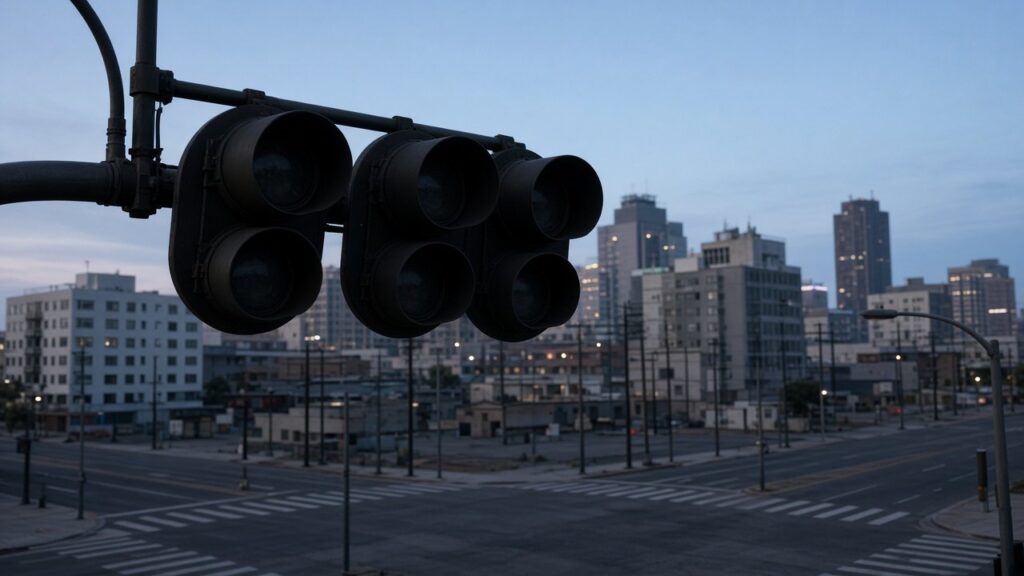
According to police, all traffic signals at the intersection were not working at the time, and it was unclear why. Everyone involved stayed at the scene, and investigators said neither alcohol nor drugs were factors. The cause of the crash was under investigation by LAPD’s West Traffic Division when this was written. We are not adding a cause, and we are not describing the vehicles in a way that could identify anyone.
What California law requires at a dark signal
When signals are out, the intersection does not become a free-for-all. Under Vehicle Code section 21800(d), a driver approaching an intersection with inoperative traffic signals must stop, and may proceed with caution only when it is safe. Many agencies describe that as treating the intersection like an all-way stop.
- Every driver stops first.
- A driver must yield to a vehicle that has already entered the intersection.
- When two vehicles from different roads arrive at the same time, the driver on the left generally yields to the driver on the right.
- Speed still matters. Vehicle Code section 22350 requires a speed that is safe for the conditions, including darkness and a dead signal.
Investigators usually ask whether each driver stopped, who entered first, how fast each vehicle was going, and what the drivers could see. Video, vehicle data, and witness accounts often decide those questions. Our guide to who is at fault when traffic lights are out covers these rules in more depth.
Who pays a passenger’s family?
A passenger usually did nothing to cause an intersection crash. That matters, because a passenger’s family can often look to more than one policy:
- The other driver’s liability insurance, if that driver was at fault in whole or in part.
- The liability insurance on the vehicle the passenger was riding in, if its driver was at fault in whole or in part. California uses comparative fault, so both drivers can share responsibility.
- Uninsured or underinsured motorist coverage on the passenger’s own policy or a household policy, if the at-fault driver’s coverage is missing or too small.
- Medical payments coverage, if the policy includes it, for some medical and funeral costs.
A family member may hesitate to make a claim when a relative or friend was driving. A claim against a driver is usually a claim against that driver’s insurance. Our article on passenger claims against an at-fault driver explains how that works, and our article on a passenger’s family claims after a Yorba Linda crash shows the same questions in another case.
Under Code of Civil Procedure section 377.60, a spouse, domestic partner, children, and certain other family members may bring a wrongful death claim. Our wrongful death and catastrophic injury page explains who may file.
Could the city or a utility be responsible?
Sometimes, but it is not automatic, and nothing reported so far shows why these signals were dark. A dark signal is treated as an all-way stop under the Vehicle Code, which makes many public-entity claims harder. Government Code sections 830.4 and 830.8 also limit liability tied to traffic signals and signs.
A closer look can make sense if the facts show more, for example a signal that malfunctioned in a misleading way, or an agency or utility that knew about a recurring outage and did not act. Who maintains the signal, and why it lost power, decides who could be involved. In the City of Los Angeles, traffic signals are generally a city responsibility, and much of the city gets electricity from the city-owned Department of Water and Power. A claim against any city department or other public entity generally must be presented in writing within six months under Government Code section 911.2. Our guide on how to file a claim against the City of Los Angeles explains the steps. Because the cause of this outage is unknown, a family should preserve that option early rather than assume it applies.
Evidence that can matter
- The LAPD traffic collision report and the name of the investigating division.
- Photos or video showing the signal heads were dark, and the time they went out and came back.
- Outage and repair records for the intersection, requested through counsel.
- Video from nearby businesses, buses, and dash cameras, requested quickly.
- Event data from both vehicles, which may show speed and braking.
- Medical, coroner, and funeral records, and proof of the family’s losses.
Deadlines
Most California wrongful death lawsuits must be filed within two years under Code of Civil Procedure section 335.1. If a city department or another public entity may be involved, the six-month claim deadline comes first. Our Los Angeles car accident page covers local steps.
Talk to us
Win Attorneys handles intersection crash, passenger, and wrongful death claims statewide from our only office at 17291 Irvine Blvd., Suite 210, Tustin, CA 92780. We speak Spanish and Vietnamese. We do not represent anyone involved in this crash.
Call us at (657) 235-8097, reach us through our contact page, or start online with our intake form.
This article is general information and is not legal advice. Reading it does not create an attorney-client relationship. It does not decide fault in the November 15, 2026 crash at Olympic Boulevard and Vermont Avenue, and it does not name anyone involved.
Sources
- MyNewsLA, “Passenger Killed in Koreatown Collision; Traffic Signals Were Out,” November 15, 2026, citing the Los Angeles Police Department. Fetched November 16, 2026. The article includes vehicle descriptions that we are not repeating.
- Korea Daily, “Koreatown car crash, Fatal Collision at Olympic and Vermont Leaves 1 Dead,” November 15, 2026, citing City News Service. Fetched November 16, 2026.
- Vehicle Code section 21800; Vehicle Code section 22350; Code of Civil Procedure section 377.60; Government Code section 911.2.
Frequently asked questions
What happened at Olympic and Vermont in Koreatown on November 15, 2026?
At about 5:50 a.m., two vehicles collided at Olympic Boulevard and Vermont Avenue, one overturned, and a passenger died at the scene, according to the Los Angeles Police Department as reported by MyNewsLA. Police said all the signals at the intersection were out and it was unclear why. Alcohol and drugs were not factors, and the cause was under investigation.
What does California law require when traffic signals are out?
Vehicle Code section 21800(d) requires a driver approaching an intersection with inoperative signals to stop and proceed with caution only when it is safe. Many agencies describe that as treating the intersection like an all-way stop.
Who pays when a passenger is killed in a two-car crash?
Often the liability insurance of whichever driver was at fault, and sometimes both, because California allows fault to be shared. The passenger’s own uninsured or underinsured motorist coverage and medical payments coverage may also apply.
Can the City of Los Angeles be responsible for a crash at a dark signal?
Only on the right facts. A dark signal is treated as an all-way stop, and Government Code sections 830.4 and 830.8 limit signal-related liability. If a city department or other public entity may be involved, a written claim is generally due within six months.
How long does a family have to file a wrongful death claim?
Most California wrongful death lawsuits must be filed within two years. A claim against a public entity generally must be presented within six months.
Do your lawyers speak Spanish or Vietnamese?
Yes. We speak Spanish and Vietnamese, and we help people statewide from our only office at 17291 Irvine Blvd., Suite 210, Tustin, CA 92780.