
Last updated · Reviewed by Ron McMinn, Esq.
A driver may make a U-turn only where the Vehicle Code permits it, and every turn must be made with reasonable safety under section 22107. Left turns have their own yielding rule in section 21801, covered in our left-turn crash guide. Section 21209 limits when a motor vehicle may enter a bike lane. Uninsured and underinsured motorist coverage and med-pay may apply even when you were not in your car, depending on your policy.
A woman riding an e-bike in an Ocean Beach bike lane suffered multiple facial fractures on Friday evening, October 23, 2026, when a minivan making a U-turn struck her, according to San Diego police. The driver was arrested on suspicion of DUI. The crash raises a question many California riders never think about until it is too late: what does the law say about drivers who turn across a bike lane?
This article briefly summarizes what has been reported, then explains the California rules on U-turns, bike lanes and yielding, and how an injured rider’s claim is usually paid.
What San Diego Police Reported
According to FOX 5 and KUSI, citing the San Diego Police Department, a 52-year-old woman was riding an e-bike eastbound in the bike lane near the 4700 block of West Point Loma Boulevard around 7:11 p.m. A 35-year-old man driving a Chrysler minivan in the same direction turned left to complete a U-turn, and the rider was hit in the eastbound lane. She suffered multiple fractures to her face. Police said alcohol was determined to be a factor, and the driver was arrested for DUI. Hoodline reported the same details.
The investigation is ongoing. An arrest is not a conviction, and no court has made any finding about fault. The people involved have not been publicly identified.
When Is a U-Turn Legal in California?
California has several U-turn rules, and which ones apply depends on where the turn happens. Among them:
- Vehicle Code section 22100.5 limits U-turns at intersections controlled by traffic signals or other official traffic control devices. They must be made from the far left lane lawfully available.
- Vehicle Code section 22102 bars U-turns in a business district except at an intersection or through an opening in a divided highway.
- Vehicle Code section 22103 bars U-turns in a residence district when any other vehicle is approaching from either direction within 200 feet, with a limited exception at controlled intersections.
- Vehicle Code section 22105 bars U-turns anywhere the driver cannot see clearly for 200 feet in both directions.
On top of these, Vehicle Code section 22107 says no driver may turn or move right or left on a roadway until the move can be made with reasonable safety, and only after giving an appropriate signal. Whether any particular U-turn was legal depends on the location, the signals and signs, and what traffic was nearby. Investigators look at all of that.
Bike Lanes: Who Belongs There
California treats bike riders as road users with real rights. Under Vehicle Code section 21200, a person riding a bicycle has the rights and duties of a vehicle driver.
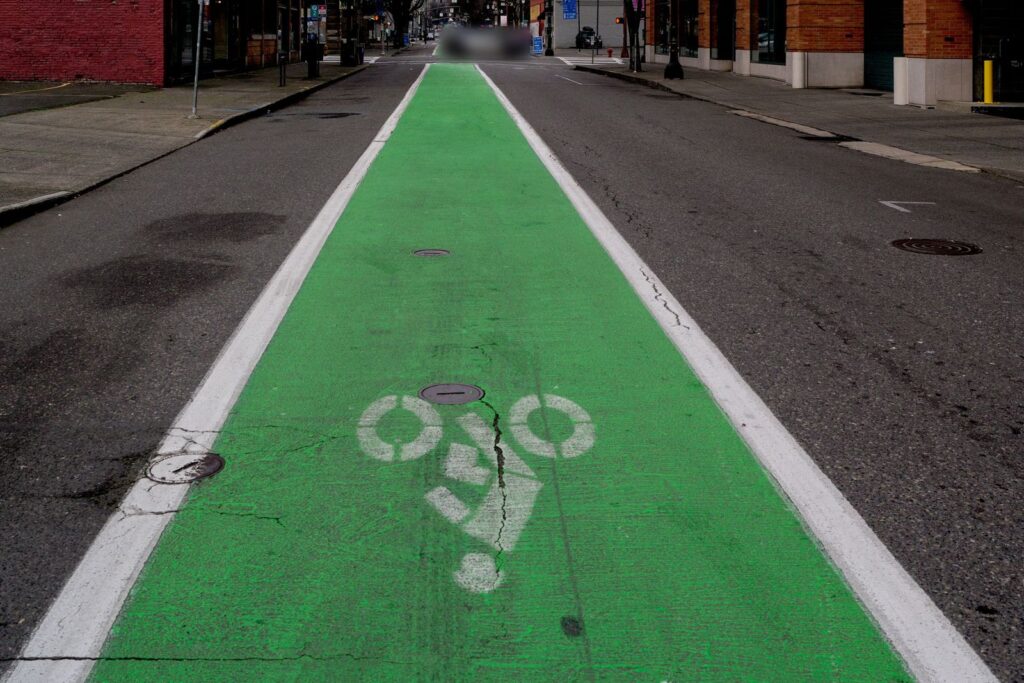
Vehicle Code section 21209 says a motor vehicle may not be driven in a bicycle lane except to park where parking is allowed, to enter or leave the roadway, or to prepare for a turn within 200 feet of an intersection. The same section allows motorized bicycles in bike lanes. When a driver does need to cross a bike lane to turn, Vehicle Code section 21717 requires the driver to move into the bike lane before making the turn.
Riders have duties too. Vehicle Code section 21208 says a bicyclist moving slower than traffic shall ride within an available bike lane, with exceptions for passing, turning left and avoiding hazards. A rider may not leave the bike lane until it can be done with reasonable safety and after a signal.
A U-turn from a travel lane can bring a vehicle across or into a bike lane where a rider is already traveling. That is why the yielding and “reasonable safety” rules matter so much in these cases.
How a Traffic Violation Becomes Evidence of Negligence
A civil injury claim is separate from any criminal case. In the civil case, California Evidence Code section 669 creates a presumption of negligence when a person violates a statute or regulation, the violation causes injury, the injury is the kind the law was designed to prevent, and the injured person is someone the law was meant to protect. This is often called negligence per se.
Traffic safety laws like the U-turn and bike lane rules are designed to prevent collisions with other road users. If a driver violated one of them and that violation caused a rider’s injuries, the presumption can help the rider’s case. The driver can try to rebut it, and the rider’s own conduct can also be weighed under California’s comparative fault rules.
What a DUI Arrest Means for the Injury Claim
Driving under the influence and causing injury is a crime under Vehicle Code section 23153. That statute also creates a rebuttable presumption that a driver had a blood alcohol concentration of 0.08 percent or more at the time of driving if a chemical test taken within three hours shows that level.
In a civil case, evidence from the DUI investigation can be important. That can include officer observations, field sobriety tests, chemical test results and any plea or conviction. An arrest by itself does not prove impairment, and the criminal case and the civil claim proceed on separate tracks.
Punitive damages
Civil Code section 3294 allows punitive damages when there is clear and convincing proof of oppression, fraud or malice. In Taylor v. Superior Court (1979) 24 Cal.3d 890, the California Supreme Court held that driving while intoxicated may support a finding of malice when the driver acted with conscious disregard of the probable dangerous consequences. Punitive damages are not automatic in DUI cases. They depend on the evidence about the driver’s conduct and state of mind.
We have covered DUI punitive damages in more depth in our article on California DUI punitive damages and Braun’s Law, and DUI crashes involving people outside a car in our Hollywood Boulevard pedestrian DUI article. For riders hit while sharing a travel lane, see our article on e-bike traffic lane crash liability.
Who Pays an Injured E-Bike Rider
Several sources of coverage can come into play:
- The driver’s liability insurance. This is usually the first source for medical bills, lost income, and pain and suffering when a driver is responsible.
- Your own uninsured and underinsured motorist coverage. Under Insurance Code section 11580.2, “insured” includes the named insured and resident relatives “while occupants of a motor vehicle or otherwise,” so this coverage can extend to people hurt while riding a bike or walking. It may help if the driver has no insurance or too little. Our UM and UIM claims page explains how it works.
- Medical payments coverage. Many auto policies include med-pay, which can help with medical bills regardless of fault, depending on policy terms. See our guide to med-pay benefits in California.
- Health insurance. Health plans may pay first and later seek reimbursement from a settlement.
Policy language controls every one of these, so it is worth getting copies of the actual policies early.
What to Do After a Bike Lane Crash
- Get medical care and follow up, especially for head and facial injuries.
- Get the police report number and the officer’s name.
- Keep the e-bike, helmet and damaged gear as they are.
- Photograph the scene, the bike lane markings, signs and signals.
- Look for nearby businesses or homes with cameras, and ask quickly before footage is overwritten.
- Avoid giving a recorded statement to the driver’s insurer before getting advice.
Most California injury lawsuits must be filed within two years under Code of Civil Procedure section 335.1. Learn more on our e-bike accidents page and our San Diego page.
New California e-bike laws that start in 2027 add class and speed labels and seller disclosures. See our guide to the new California e-bike laws and how they may affect an injury claim.
Frequently Asked Questions
Can a driver make a U-turn across a bike lane in California?
A U-turn is allowed only where the Vehicle Code permits it, and every turn must be made with reasonable safety under section 22107. Section 21209 limits when a motor vehicle may enter a bike lane.
Are e-bikes allowed in California bike lanes?
Generally, yes. Vehicle Code section 21209 allows motorized bicycles in bike lanes, and riders have the rights and duties of drivers under section 21200.
Does a DUI arrest prove the driver was at fault?
No. An arrest is not a finding. Evidence from the DUI investigation can still be important in a civil claim, and a traffic law violation can create a presumption of negligence under Evidence Code section 669.
Can I get punitive damages after a DUI crash?
Possibly. Under Taylor v. Superior Court and Civil Code section 3294, intoxicated driving may support punitive damages if malice is proved by clear and convincing evidence.
Does my car insurance cover me if I was hit on my e-bike?
Often, yes. Uninsured and underinsured motorist coverage and med-pay may apply even when you were not in your car, depending on your policy.
Talk to us
If you were hurt while riding, Win Attorneys serves clients across California. We speak Spanish and Vietnamese. Call (562) 296-5380 or reach us through our contact page.
Office: 17291 Irvine Blvd., Suite 210, Tustin, CA 92780. Visits are by appointment.
This article is general information for educational purposes. It is not legal advice and does not create an attorney-client relationship. Crash details are attributed to FOX 5 and KUSI, citing the San Diego Police Department, and to Hoodline as of October 26, 2026, and may change as the investigation continues. No fault is assigned to anyone. Outcomes depend on the facts of each matter. Seek medical care for injuries, and consult a licensed California attorney about your situation.