
Last updated
Short answer: If a driver with Mexican insurance or Baja California plates causes a crash in California, that driver, and sometimes the vehicle’s owner, may be legally responsible for your injuries. Payment may come from a U.S. liability policy bought for the trip, a Mexican policy that extends liability coverage into the United States, the driver’s own assets, or your own uninsured motorist coverage if no policy applies or the insurer denies coverage. A Baja plate by itself does not mean the driver is uninsured.
Why this question comes up in Chula Vista
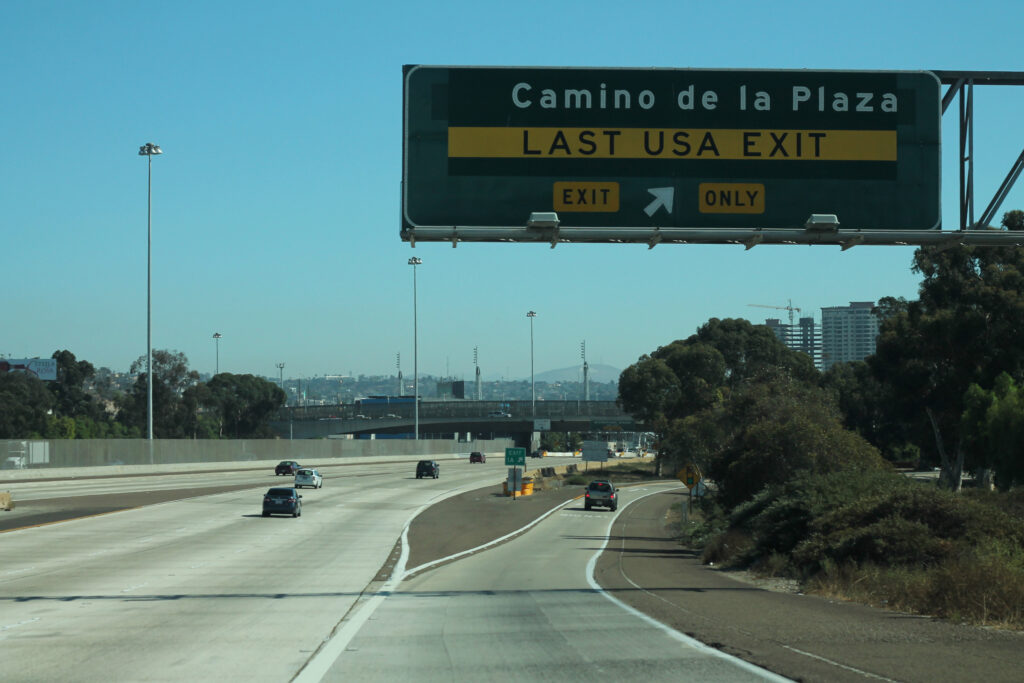
Chula Vista sits between San Diego and the border. Interstate 5 and Interstate 805 run south toward San Ysidro, and the State Route 125 toll road runs south to State Route 905 near the Otay Mesa port of entry.
After a crash with a driver from Baja California, injured people may ask: “Their insurance is from Mexico. Will anyone pay?” The honest answer is that it depends on the policy and the facts, not on the plate.
What California requires of every driver
California’s insurance rules apply to anyone driving here, whatever the vehicle’s home state or country.
- Every driver and owner must be able to show financial responsibility at all times and carry proof of it in the vehicle (Vehicle Code section 16020).
- Minimum liability limits. For policies issued or renewed on or after January 1, 2025, the minimum is $30,000 for injury or death of one person, $60,000 for injury or death of two or more people, and $15,000 for property damage in one crash (Vehicle Code section 16056).
- Vehicles registered outside California. For a vehicle not registered here, a policy counts under these financial responsibility rules only if the insurer is admitted to do business in California or has signed a power of attorney letting the California DMV accept legal papers for it (Vehicle Code section 16056, subdivision (b)).
In plain terms, some policies sold in Mexico meet that test and some do not. That affects the driver’s proof-of-insurance duties after a crash. It does not, by itself, decide whether a policy will pay your claim. Only the policy’s own terms answer that.
Where the money may come from
After a crash with a Mexico-registered vehicle, a careful claim usually looks at several possible sources at once.
- A U.S. liability policy bought for the trip. Some drivers who cross from Mexico buy a separate U.S. auto liability policy for their time in California. Ask for the insurer’s name, the policy number and the dates of coverage.
- A Mexican policy that includes U.S. liability coverage. Some insurers in Mexico sell liability coverage meant for trips into the United States and Canada. Whether it applies depends on the policy’s territory, dates, limits and exclusions, so the policy document matters more than the insurance card.
- The vehicle’s owner. If the driver was using someone else’s vehicle with permission, Vehicle Code section 17150 can make the owner responsible too. Section 17151 limits that owner liability to $15,000 for one person and $30,000 for more than one person, unless the owner is responsible for another reason, such as an employer relationship.
- The driver personally. A driver who causes a crash may be personally responsible even without insurance. Collecting from someone whose property is in Mexico can be slow and difficult in practice, so this is rarely the first place to look.
- Your own uninsured motorist coverage. This is often the most important protection, and it is explained below.
- Medical payments coverage and health insurance. If you bought medical payments coverage, it can help with medical bills regardless of fault, subject to your policy.
How your uninsured motorist coverage can step in
California auto policies must include uninsured motorist (UM) coverage unless the named insured agreed in writing to delete it or to lower it (Insurance Code section 11580.2). That coverage matters in cross-border crashes because of how the law defines an “uninsured” vehicle.
Under section 11580.2, a vehicle can count as uninsured when:
- there is no bodily injury liability insurance that applies at the time of the crash;
- there is a policy, but the insurer denies coverage, or admits coverage only conditionally or with a reservation;
- the at-fault driver’s insurer cannot pay because it is insolvent, under the conditions the statute lists; or
- the driver is unknown, as in a hit-and-run, if there was physical contact and the other reporting conditions in the statute are met.
The same section also provides underinsured motorist coverage when the other driver’s limits are lower than yours and those limits have been paid.
UM coverage has its own time rule. Within two years of the crash, you generally must file suit against the uninsured driver, reach an agreement with your insurer on the amount owed, or formally start arbitration by certified mail, as section 11580.2 describes.
What to collect after the crash
If you are able, or if someone can help you, gather:
- the driver’s full name, phone number, address and driver’s license, including the issuing country or state;
- the insurance card and any policy paper: insurer name, policy number, coverage dates and whether it mentions the United States;
- the plate number and the state that issued it, plus a description of the vehicle;
- photos of the vehicles, the scene, the road and your injuries;
- the report number from the police officer or Highway Patrol officer who responded; and
- names and phone numbers of witnesses.
Tell your own insurer about the crash promptly, and read the notice terms in your UM coverage.
Deadlines to keep in mind
- Lawsuit against the driver: generally two years from the injury (Code of Civil Procedure section 335.1).
- Uninsured motorist claim: suit, agreement or a formal arbitration demand within two years of the crash (Insurance Code section 11580.2).
- If a public agency is involved, such as a government vehicle or a dangerous road condition, a written claim is generally due within six months (Government Code section 911.2).
This article covers crashes that happen in California. A crash in Mexico raises different laws and is outside this guide.
Mistakes that can hurt a claim
- Assuming no one will pay because the plate is from Baja California.
- Leaving the scene with only a photo of an insurance card and no policy number.
- Waiting to notify your own insurer.
- Signing a release before you know the full extent of your injuries.
How Win Attorneys can help
Win Attorneys helps injured people throughout California from our Tustin office at 17291 Irvine Blvd., Suite 210, Tustin, CA 92780. We speak Spanish and Vietnamese, which helps when a policy, a report or a conversation with the other driver happened in Spanish. Call (657) 235-8097.
You may also find these pages useful: Chula Vista personal injury lawyer, California’s 30, 60 and 15 minimum insurance limits, uninsured and underinsured motorist claims, Otay Mesa, San Ysidro and border truck claims and protecting a Chula Vista crash claim while the report is pending.
This article is general information about California law, not legal advice for your situation.
Frequently asked questions
Does Mexican car insurance cover a crash in California?
Sometimes. It depends on whether the policy includes liability coverage in the United States, and on its dates, limits and exclusions. Some drivers also buy a separate U.S. policy for their trip. The policy document, not the plate, answers the question.
Does a Baja California plate mean the driver has no insurance?
No. Many drivers with Mexican plates carry coverage that applies in California. The plate tells you where the vehicle is registered, not whether it is insured.
What if the other driver’s insurer denies coverage?
Under Insurance Code section 11580.2, a vehicle can be treated as uninsured when its insurer denies coverage or admits it only conditionally or with a reservation. In that case, your own uninsured motorist coverage may apply, subject to your policy.
What minimum insurance must drivers carry in California?
For policies issued or renewed on or after January 1, 2025, the minimum is $30,000 for one person’s injury or death, $60,000 for two or more people, and $15,000 for property damage, under Vehicle Code section 16056.
Can I sue a driver who lives in Mexico?
A California court is usually where a claim over a California crash is brought. Collecting a judgment from someone whose property is in Mexico can be difficult, which is why insurance, including your own uninsured motorist coverage, is often the practical source of payment.
What if the driver with Mexican plates drove away?
Your uninsured motorist coverage may apply to a hit-and-run if there was physical contact with you or your vehicle and the reporting conditions in Insurance Code section 11580.2 are met, including a report to police within 24 hours and a sworn statement to your insurer within 30 days.
How long do I have to make a claim?
Generally two years to sue the at-fault driver (Code of Civil Procedure section 335.1), and two years to file suit, reach agreement or demand arbitration on an uninsured motorist claim. If a public agency may share responsibility, a written claim is usually due within six months.