
Last updated
By Ron McMinn, Esq. | Last updated: November 11, 2026.
Read this article in Español.
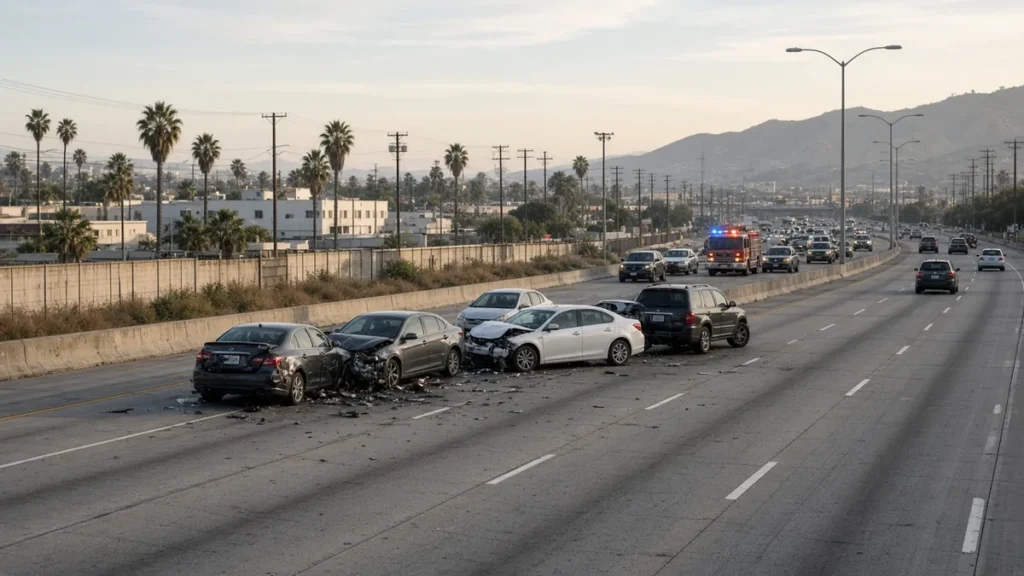
When several vehicles collide on a California freeway or off-ramp, the first question many injured people and families ask is who pays. More than one driver may share fault. More than one insurer may be involved. A passenger’s claim can look different from an injured driver’s claim, and a family that lost someone may have a wrongful death claim of its own. On the morning of November 9, 2026, the California Highway Patrol reported a multi-vehicle crash on the northbound Interstate 5 off-ramp to Genesee Avenue in the University City area of San Diego. One person died, and several other people were taken to hospitals. Reporting has not made clear what led to the crash. This article does not decide who was at fault, and it does not name anyone involved.
What has been reported about the I-5 Genesee Avenue off-ramp pileup?
The San Diego Union-Tribune, citing the California Highway Patrol, reported a crash involving six vehicles early Monday, November 9, 2026, in the University City area. The CHP said the crash was reported shortly before 8 a.m. on the off-ramp from northbound I-5 to Genesee Avenue. A San Diego police officer who responded performed CPR on a severely injured person. That person was taken to a hospital and later died, the CHP told the Union-Tribune.
The Union-Tribune reported that the off-ramp was closed for more than an hour and reopened to traffic around 9:45 a.m. Multiple people were taken to hospitals for injuries from the crash. Authorities did not release details about the extent of those injuries, about what led to the crash, or about the person who died.
Hoodline repeated those CHP details and compared them with a CHP incident log published on chpfatal.com. That log initially recorded a four-vehicle collision at 7:55 a.m. and then a five-vehicle collision a minute later. Hoodline noted that those early entries were preliminary and that the final vehicle count had not been independently reconciled in the records it reviewed. This firm is not adopting a vehicle count of its own.
A shared note in that CHP incident log, recorded at 7:58 a.m., stated that a white van did not stop and collided into other vehicles. That is a preliminary dispatch entry, not a finding of fault, and it has not been independently confirmed in the Union-Tribune report. The same log shows that at 8:06 a.m. CHP reported CPR in progress and asked that the Genesee off-ramp and the adjoining on-ramp be closed, and that by 8:11 a.m. police had the northbound I-5 off-ramp to Genesee Avenue shut down.
We are not naming anyone who was hurt or killed. These are attributed reports, not findings by this firm. They do not establish fault, speed, or the sequence of impacts, and they do not show that the design or condition of the off-ramp played any role.
Who may pay after a multi-car freeway or off-ramp pileup?
In a pileup, payment often comes from more than one place. Each driver who shares responsibility may have a liability policy. Those policies can be claimed against at the same time, and they can run out quickly when several people are hurt or when someone has died.
Liability insurance for each at-fault driver. Under Civil Code section 1714, everyone is responsible for harm caused by a lack of ordinary care. If the evidence shows that more than one driver failed to use ordinary care, more than one insurer may have to contribute. Our article on who pays after a multi-car freeway pileup in California explains how those policies can overlap, and what happens when the limits are too small for everyone who was hurt.
Passengers. A passenger is rarely the person who caused the crash. Depending on the evidence, a passenger may have a claim against the driver of the car they were riding in, against one or more other drivers, or against both. A passenger’s claim usually does not depend on winning an argument about which driver was most at fault.
Injured drivers. An injured driver can still have a claim against other drivers even if that driver shares some fault. California’s comparative fault rules, discussed below, can reduce the recovery. They do not automatically erase it.
Your own household coverage. Uninsured and underinsured motorist coverage, often called UM and UIM, can help when a responsible driver has no insurance, not enough insurance, or cannot be identified. Medical payments coverage on a household policy may help with medical bills no matter who was at fault. Policy definitions matter. Our page on UM and UIM claims explains those layers, and our motor vehicle accidents page covers California car crash claims more broadly.
How does fault work in a chain-reaction pileup?
The order of the impacts matters. A driver who struck the car ahead may have been pushed from behind. A lead vehicle may have braked suddenly or been stopped on the ramp. Some vehicles may have been hit more than once. The last driver in the line is not automatically at fault. Our article on who is at fault in a California chain-reaction freeway crash walks through how that sequence is rebuilt.
Vehicle Code section 21703 says a driver shall not follow another vehicle more closely than is reasonable and prudent, having due regard for speed and for the traffic on the highway. If its conditions are met, Evidence Code section 669 can allow a court to presume negligence from a statute violation that caused the injury. That presumption can be rebutted. In a pileup, evidence about who hit whom first, whether a driver was pushed, and what each person could see and do in the last few seconds can change the picture.
California uses comparative fault. In Li v. Yellow Cab Co. (1975) 13 Cal.3d 804, the California Supreme Court replaced the old all or nothing rule with a system that divides responsibility by percentage. If an injured driver shares fault, a claim can be reduced, but it is not erased. Under Civil Code section 1431.2, each responsible person can be liable for the full amount of economic losses, such as medical bills and lost income, while non-economic losses, such as pain and suffering, are generally divided by each person’s share of fault. That is why identifying every potentially responsible driver, and every policy, matters early.
What claims may a family have after a death?
When a crash causes a death, Code of Civil Procedure section 377.60 allows certain family members to bring a wrongful death claim. In general terms, that group can include a surviving spouse or domestic partner and children, and in some situations other people who depended on the person who died. The statute, not a news report, decides who qualifies. A wrongful death claim covers the family’s own losses, such as lost financial support and the loss of love, companionship, and guidance.
A separate survival claim, brought through the estate under Code of Civil Procedure section 377.30, covers certain losses the person suffered before death. Section 377.34 limits what that claim can recover. Both kinds of claim still depend on evidence of fault. In a multi-vehicle crash, more than one driver may share that responsibility.
Public reporting on this crash has not said whether the person who died was a driver or a passenger. That fact can affect which policies and which claims are in play, and it should be confirmed from the CHP investigation and the family’s own records, not from early news accounts. Our page on wrongful death and catastrophic injury claims explains those family claims in general terms.
Do Caltrans or government-claim deadlines apply?
An Interstate 5 off-ramp is a state highway facility, generally maintained by Caltrans. A crash on that kind of ramp does not, by itself, show that the road was dangerous or that a public entity is responsible. A claim against a public entity depends on evidence that a condition of public property played a role in causing the crash.
Nothing in the reporting on this crash suggests that the road was a cause, and this article does not suggest it. If evidence later points that way, Government Code section 911.2 generally requires a written government claim within six months for injury or death. That deadline is much shorter than the usual two-year period for many injury and wrongful death lawsuits under Code of Civil Procedure section 335.1. Our guide on how to file a claim against Caltrans explains that process for the cases where it actually applies. Insurance policies can also have their own notice and arbitration requirements, including for UM and UIM claims.
What should passengers and injured drivers do now?
Medical care comes first. After that, a few steps protect a claim while a multi-vehicle investigation is still open:
- Ask the CHP for the collision report number and keep it with the hospital paperwork.
- Find every auto policy that may apply: the policy on the car you were in, the policies of the other vehicles, and every policy in your own household.
- Keep photographs already taken, medical records, discharge papers, and receipts.
- Write down the other vehicles you remember, including colors, types, and any license plates, and the names of witnesses if you have them.
- Ask early about vehicle data and about camera footage from the ramp, the freeway, nearby businesses, or other cars, before vehicles are salvaged or footage is overwritten.
- Do not give a recorded statement to an insurer for another driver before you understand your rights.
- Do not post medical details or guesses about fault on social media.
We help people across San Diego, including University City, and throughout California. Our San Diego car accident page and our San Diego injury page explain how we work with clients in the area. We work statewide from our Tustin office. We do not have a San Diego office.
Talk to us
If you were hurt, or if you lost a family member, in a California freeway or off-ramp pileup, Win Attorneys handles motor vehicle, wrongful death, and UM and UIM matters statewide from our Tustin office. We speak Spanish and Vietnamese. We do not claim to represent anyone involved in the University City crash described above.
Call us at (657) 235-8097, reach us through our contact page, or start online with our intake form. Office: 17291 Irvine Blvd., Suite 210, Tustin, CA 92780.
This article is general information and is not legal advice. Reading it does not create an attorney-client relationship. News accounts of this crash were preliminary as of November 11, 2026, and what led to the crash had not been established in the reporting.
Frequently asked questions
Who pays after a multi-car freeway or off-ramp pileup in California?
It depends on the evidence. Each driver who shares fault may have a liability policy that can pay. A passenger can often claim against more than one driver. An injured driver can still recover even if that driver shares some fault, though the recovery can be reduced. Household uninsured and underinsured motorist coverage may also apply.
Is the last driver in a chain-reaction crash always at fault?
No. A rear driver who follows too closely can be presumed careless, but that presumption can be rebutted. A driver may have been pushed from behind, and several drivers can share fault. The sequence of impacts has to be rebuilt from the evidence.
Can a passenger make a claim after a freeway pileup?
Often yes. A passenger is rarely the person who caused the crash. Depending on the evidence, a passenger may claim against one at-fault driver or against more than one, and may also look to household uninsured or underinsured motorist coverage.
What if several drivers share fault?
California uses comparative fault, so a claim can be reduced by a person’s own share of fault but is not erased. For economic losses, such as medical bills and lost income, each responsible person can be liable for the full amount. Non-economic losses, such as pain and suffering, are generally divided by each person’s share of fault.
What claims may a family have if someone dies in a pileup?
Code of Civil Procedure section 377.60 decides who may bring a wrongful death claim. In general that can include a surviving spouse or domestic partner and children, and in some cases other people who depended on the person who died. A separate survival claim can cover certain losses the person suffered before death.
Does a crash on an I-5 off-ramp mean Caltrans is responsible?
No. A crash on a state highway or off-ramp does not, by itself, show that the road was dangerous. A road claim depends on evidence about the road and whether it helped cause the crash. Nothing in the reporting on this crash suggests that the road was a cause.
How long do injured people and families have to file a claim?
Many California injury and wrongful death lawsuits must be filed within two years. If a public entity may share responsibility, a written government claim is generally due within six months. Insurance policies can also have their own notice and arbitration deadlines.
Do Win Attorneys’ lawyers speak Spanish or Vietnamese?
Yes. We speak Spanish and Vietnamese, and we help people statewide from our office at 17291 Irvine Blvd., Suite 210, Tustin, CA 92780. Call (657) 235-8097 or start online with our intake form.