
Last updated
When a freight train hits a person at a California railroad crossing, the railroad that ran the train may be responsible, and so may others: whoever maintained the crossing signals, the public agency that controls the road and its approach, and sometimes a driver. Which of them, if any, depends on evidence that can disappear quickly, including the train’s event recorder, the crossing signal records and the maintenance logs. A claim against a public agency generally must begin with a written government claim within six months, while a lawsuit against a private railroad is generally due within two years. This guide explains the rules in plain terms. It is general information and says nothing about who caused any particular crash.
What was reported about the Fresno crash?
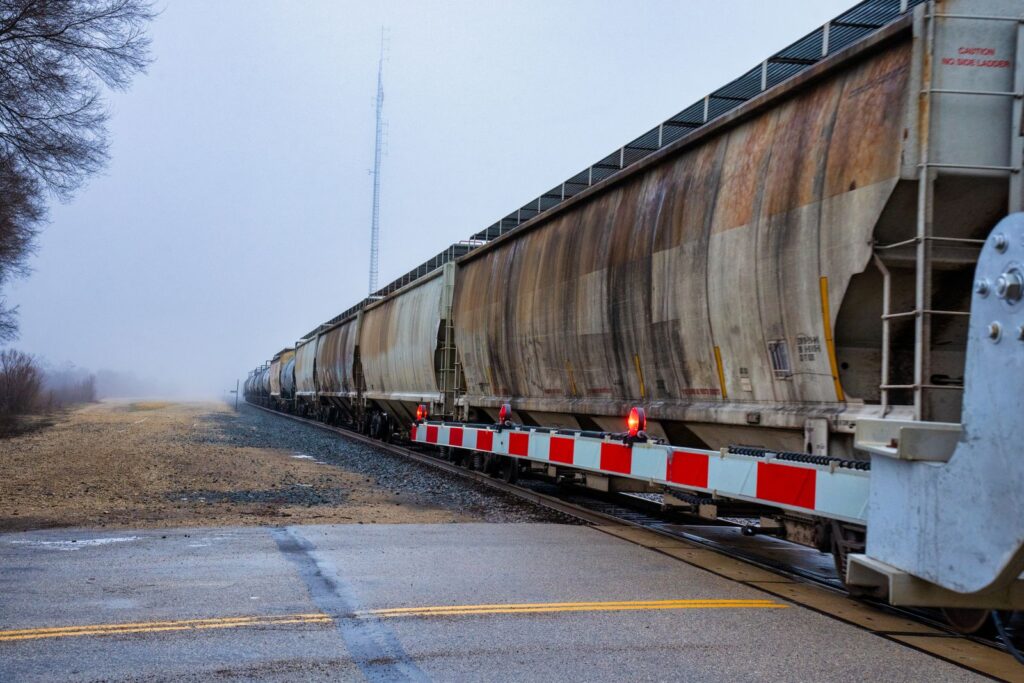
On Monday, November 2, 2026, Fresno police responded shortly before 2:45 p.m. to the area of North and Golden State after a report that a person had been hit by a train, according to KMPH (FOX26). The Fresno Bee reported that a pedestrian was struck and killed by a BNSF freight train at a crossing near Golden State Boulevard and North Avenue, and that BNSF is investigating. We are not repeating any names, and we are not assigning fault to anyone. Nothing in the reports explains what led to the collision.
Our hearts go out to the family and to everyone affected. The rest of this page is a general guide to how California and federal law treat these cases.
Who can be responsible after a freight train hits someone at a crossing?
Short answer: possibly several parties, and no one can say which until the facts are gathered. Four groups are usually looked at.
- The railroad. The company that ran the train, and sometimes a separate company that owns the track or dispatches trains, may owe a duty of reasonable care in how the train was operated, including its speed, braking, lookout and horn. Federal rules generally require the lead locomotive’s horn to be sounded as a train approaches a public crossing, with exceptions (49 CFR 222.21).
- Whoever maintains the crossing warning system. Federal rules for the blue-sign reporting system call this the “maintaining railroad,” the entity, such as a track owner or lessee, responsible for maintaining the warning devices, and a contractor who handles that work counts as the maintaining railroad (49 CFR 234.301). Lights, bells and gates must work as intended and be tested on a schedule.
- A public entity. A city, county or state agency may control the road, the approach to the crossing, signs, striping, sight lines, a sidewalk or pathway, or traffic signals tied to the crossing. A claim against a public entity usually rests on a dangerous condition of public property under Government Code section 835, and the entity may raise design immunity under section 830.6. Our guide to suing the government over a dangerous road or sidewalk walks through both.
- Drivers and property owners. A driver whose carelessness contributed, or an owner of nearby property whose plants or structures blocked the view of an approaching train, can also be part of the picture. Federal rules let the public report a blocked view or a malfunction to the railroad by phone, and the railroad must act on a report of an obstruction if it is lawful and feasible to remove it (49 CFR 234.303 and 234.305).
Listing a party here does not mean that party did anything wrong. It means the evidence has to be checked.
How do federal rail rules affect a California injury claim?
Railroads are regulated by the federal government, and federal law can limit what a state-law claim may argue. That limit is called preemption. In plain terms, 49 U.S.C. 20106 says railroad safety rules should be nationally uniform to the extent practicable, and a state may keep its own rule until the federal government issues a regulation covering the same subject matter.
The same statute also protects injured people. It says nothing in it preempts a state-law lawsuit for personal injury or death that alleges a party failed to comply with a federal standard of care set by a federal regulation or order, failed to comply with its own plan, rule or standard created under a federal regulation or order, or violated a state law that is not incompatible with the uniformity rule. So a claim that a railroad broke a federal rule, or its own required rule, can go forward in state court. A claim that depends on a state-law standard the federal rules already cover can be challenged.
Federal rules also shape crossing equipment. Where federal-aid funds helped pay for warning devices, 23 CFR 646.214 calls for automatic gates with flashing lights when certain conditions exist, such as multiple main line tracks, high speed train operation combined with limited sight distance, or a diagnostic team’s recommendation. A railroad or agency may argue that federal rules decide whether the devices at a given crossing were adequate. Whether that argument works depends on the crossing’s history and the exact theory of the claim, which is one reason early legal review matters.
What evidence should be preserved after a train crash?
Much of the key evidence is in the hands of the railroad or a public agency, and some of it is overwritten on a schedule. These are the main items.
- The locomotive event recorder. Under 49 CFR 229.135, the lead locomotive of a train operated faster than 30 miles per hour must have an in-service event recorder. Depending on the locomotive, it records data such as train speed, time, distance, throttle position, brake applications, horn control handle activation and headlight switch position. It records the most recent 48 hours of operation. After an accident that must be reported to the Federal Railroad Administration (FRA), the railroad must preserve the data for FRA analysis, but that duty expires one year after the accident unless FRA or the National Transportation Safety Board notifies the railroad in writing that it wants the data. A family should not assume the railroad will keep it longer for a private lawsuit.
- Forward-facing video. Do not assume a freight locomotive has a camera. The federal image recording rule in 49 CFR 229.136 applies to lead locomotives in commuter or intercity passenger service, with a compliance date of October 12, 2027. A freight locomotive may or may not have a camera, and a lawyer can ask in writing whether one existed and what it recorded.
- Crossing signal and warning system records. Each crossing warning system must be tested at least once each month and whenever it is modified or disarranged (49 CFR 234.257). The railroad must keep records of each credible report of a warning system malfunction, including the time, the actions taken and the time of repair, for at least one year (49 CFR 234.109), and must report each activation failure to FRA within 15 days (49 CFR 234.9).
- Calls to the number on the blue sign. Crossings carry a sign with a phone number to call and the crossing’s U.S. DOT inventory number. Railroads must keep records of reports of unsafe conditions for at least one year (49 CFR 234.313). Ask for any calls about this crossing.
- The federal accident report. Each highway-rail grade crossing accident must be reported to FRA on Form FRA F 6180.57, regardless of damage or whether anyone was hurt (49 CFR 225.19). That report is part of the paper trail to ask about.
- Maintenance and inspection records. Records for the track, signals, gates, crossing surface, vegetation and signal timing, plus any earlier complaints or prior collisions at the crossing.
- Evidence on the ground. The police report, 911 audio and dispatch logs, business, home and traffic camera video, photographs of sight lines and signs, and witness names. Video and audio are often erased within days.
A written preservation letter asks the railroad, the maintaining company and any public agency to keep these items. It cannot ensure that nothing is lost, which is why it should go out quickly. Our train accident guides explain what evidence fades fast after a rail crossing crash and what event recorders and signal logs can show.
What are the deadlines?
- Two years for most lawsuits. A personal injury or wrongful death lawsuit against a private defendant, such as a railroad, generally must be filed within two years under Code of Civil Procedure section 335.1.
- Six months for a claim against a public entity. A written claim for injury or death generally must be presented to the public entity within six months under Government Code section 911.2. If the entity rejects the claim in writing, a lawsuit generally must be filed within six months of the notice, and if it never gives written notice, within two years (section 945.6).
- Late claims are narrow. An application to present a late claim is possible only in limited situations and must be made within a set time under section 911.4. Do not count on it.
- A new form rule in 2027. Starting in 2027, a government claim must include a declaration that, on information and belief, its contents are true and correct. See our post on the AB 2529 declaration rule.
A crossing case can involve a private railroad and a public entity at once. When it does, plan around the shorter clock. Our government claims page explains the process. If a public entity may share responsibility, also see what SB 577 changes for lawsuits filed on or after January 1, 2027.
What can a family claim after a death at a crossing?
Under Code of Civil Procedure section 377.60, a wrongful death claim may be brought by the surviving spouse or domestic partner, the children, and the children of a deceased child. If there is no surviving issue, it may be brought by those who would inherit the person’s property by intestate succession. Certain dependents, such as a parent who depended on the person for support, may also qualify. The personal representative can bring the claim on their behalf. Damages are those that are just under all the circumstances (section 377.61). California’s jury instruction on adult wrongful death damages (CACI No. 3921) lists economic losses such as lost financial support, household services and funeral and burial costs, and non-economic losses such as the loss of love, companionship, comfort, care, protection and moral support. It says a family’s own grief and mental anguish are not part of the award.
A separate survival claim covers the losses the person incurred before death. For lawsuits filed on or after January 1, 2026, it does not include pain and suffering (section 377.34). If the person who died was a child, see our guide to who can file a wrongful death claim after a child dies.
Shared fault is a common argument in train cases. California’s jury instruction on the decedent’s fault (CACI No. 407) says that if a defendant proves the person who died was negligent and that this was a substantial factor in the death, the family’s damages are reduced by that person’s percentage of responsibility. The claim is reduced, not erased. Our page on wrongful death and catastrophic injury and our article on wrongful death claims after a Metro train crash cover these rules in more depth.
What should you do now?
- Get medical care. If you were hurt or witnessed the crash, see a doctor and keep the records.
- Photograph the crossing. Include the signals, gates, signs, the blue sign with the phone number and the view in each direction. Do it soon, because conditions change.
- Write down names and times. Save witness contact information, the 911 call time, the officer’s name and the report number.
- Be careful with statements. A railroad’s claims representative or an insurer may call quickly. You are generally not required to give a recorded statement to a railroad representative or another party’s insurer, and you should not sign a release without legal advice.
- Write the clock dates down. Mark both the six-month and two-year dates, and ask a lawyer which applies.
- Ask for preservation early. A lawyer can send letters to the railroad, the maintaining company and public agencies. See our train accidents page.
Frequently asked questions
Who can be responsible after a freight train hits a pedestrian at a California crossing?
Possibly the railroad, the company that maintained the crossing signals, a public agency that controls the road and approach, a driver, or a nearby property owner. Which of them, if any, depends on the evidence.
Does federal law stop a lawsuit against a railroad?
Not automatically. Federal law can limit some state-law theories, but 49 U.S.C. 20106 says a state-law claim may proceed if it alleges a party failed to comply with a federal standard of care, its own federal-rule-based plan or a compatible state law.
What does a locomotive event recorder show?
Depending on the locomotive, it can record train speed, time, distance, throttle position, brake applications, horn control handle activation and headlight switch position. The railroad must preserve the data after a reportable accident for one year unless FRA or the NTSB asks for more time.
Do freight trains have forward-facing cameras?
Not necessarily. The federal image recording rule covers lead locomotives in commuter or intercity passenger service. A lawyer can ask the railroad in writing whether a freight locomotive had a camera.
How long do I have to file a claim after a train crash?
Generally two years for a lawsuit against a private railroad and six months to present a government claim if a public entity may be responsible. Use the shorter date until a lawyer confirms which applies.
Can a family still claim if the person who died may share fault?
Yes. California uses comparative fault, so damages are reduced by the person’s percentage of responsibility rather than barred.
Freight crossing claims are not the same as passenger-rail claims. If the train was Amtrak rather than a freight railroad, start with our Amtrak accident claims page. For Los Angeles Metro, Metrolink and other California rail injuries, see our California train accident lawyers hub.
Talk to us
If you were hurt in a crash involving a train, or lost someone you love, we are here to listen and to explain your options. Win Attorneys is a California firm that represents injured people throughout the state. Talk to us at (562) 296-5380. We speak Spanish and Vietnamese.
Hablamos español. Chúng tôi nói tiếng Việt.
Win Attorneys, 17291 Irvine Blvd., Suite 210, Tustin, CA 92780. Phone (562) 296-5380.
This article is general information and is not legal advice. Reading it does not create an attorney-client relationship.
Sources: The Fresno Bee, November 2, 2026, KMPH (FOX26), November 2, 2026, 49 U.S.C. 20106, 49 CFR 229.135, 229.136, 49 CFR 234.257, 49 CFR 225.19, 23 CFR 646.214, Code of Civil Procedure section 377.60, Government Code section 911.2.