

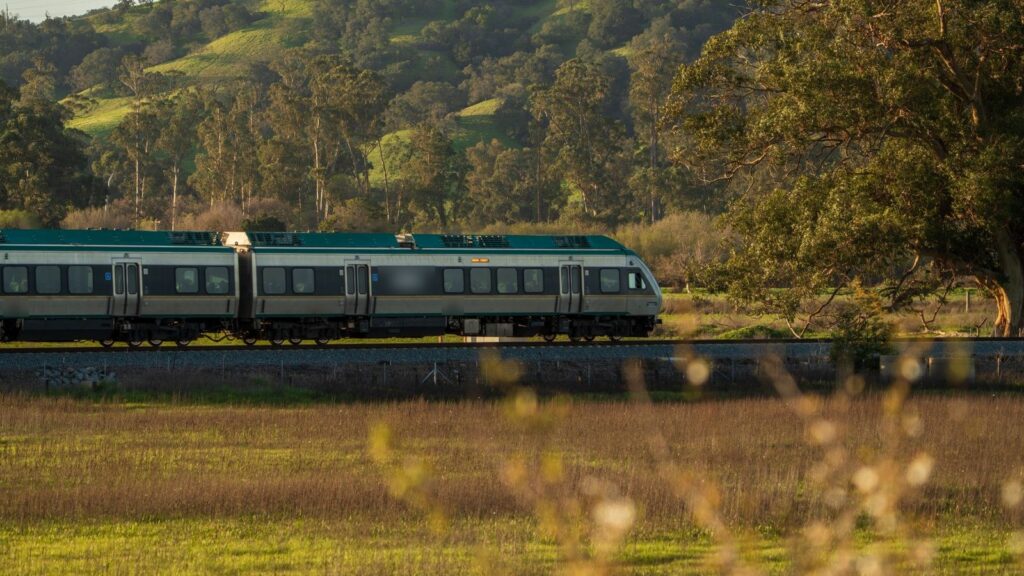
Amtrak carries Californians every day on the Pacific Surfliner along the coast, the Capitol Corridor in Northern California, the Gold Runner through the Central Valley, and long-distance trains that cross the state. Most trips end safely. When one does not, an Amtrak injury claim follows rules that are different from an ordinary car crash and different from a claim against a city bus.
Three issues surprise most injured riders. Amtrak is not a government agency for injury purposes, so the usual California public entity rules may not apply to Amtrak itself. Amtrak’s ticket terms contain an arbitration agreement that reaches personal injury claims. And the public agencies that manage California’s state-supported routes may still require a six-month government claim. This page explains each one in plain language.
Who Runs Amtrak Service in California
Amtrak operates the trains, but California’s three state-supported corridors are managed by regional joint powers authorities:
- Pacific Surfliner. Administered by the LOSSAN Rail Corridor Agency, with the Orange County Transportation Authority providing management support. It runs between San Luis Obispo, Los Angeles and San Diego.
- Capitol Corridor. Managed by the Capitol Corridor Joint Powers Authority, with BART providing day-to-day management support. It links the Sacramento region, the East Bay and San Jose.
- Gold Runner. Formerly the San Joaquins, renamed in November 2025. It is managed by the San Joaquin Joint Powers Authority and connects the Bay Area and Sacramento with the Central Valley.
Many trips also use track owned by other railroads or agencies, stations owned by cities or transit agencies, and connecting buses. Each of those owners can matter when you sort out who may be responsible.
Amtrak Is a Corporation, Not a Government Agency
Federal law says Amtrak “shall be operated and managed as a for-profit corporation” and “is not a department, agency, or instrumentality of the United States Government” (49 U.S.C. section 24301). That has a practical effect in California. The six-month government claim rule in Government Code section 911.2 applies to public entities, so it generally does not apply to a claim against Amtrak alone.
Instead, the general two-year deadline for personal injury and wrongful death in Code of Civil Procedure section 335.1 usually applies to Amtrak. Two years can pass quickly while you are treating, and other deadlines may be shorter, so do not plan around the longest one. If an Amtrak train hit a vehicle, see our guide to who pays passengers, drivers and bystanders.
When the six-month rule can still apply
The joint powers authorities that manage California routes are public entities. Under Government Code section 6507, a joint powers agency “is a public entity separate from the parties to the agreement.” If a claim may involve one of these agencies, a public station owner, a public transit agency or a city that controls a crossing, a written government claim may be due within six months of the injury. Our government claims guide explains how that process works.
The Duty Amtrak Owes Passengers
California holds carriers of passengers to a high standard. Civil Code section 2100 says a carrier of persons for reward “must use the utmost care and diligence for their safe carriage, must provide everything necessary for that purpose, and must exercise to that end a reasonable degree of skill.” A carrier is not an insurer of every rider’s safety, but the standard is higher than the ordinary care most drivers owe.
That duty can cover what happens on the train and during boarding and leaving it. In Lopez v. Southern California Rapid Transit District (1985) 40 Cal.3d 780, the California Supreme Court held that a public carrier owes passengers the utmost care to protect them from assaults by fellow passengers, where the carrier knew or had reason to know an assault could occur and could reasonably have prevented it.
Common ways passengers get hurt
- Derailments and collisions, including collisions with vehicles at grade crossings
- Sudden stops or jolts that throw standing or walking passengers
- Falls in aisles, on stairs inside bilevel cars, or between cars
- Gaps between the platform and the train, and missing or poorly placed step stools
- Luggage falling from overhead racks
- Assaults by other passengers after warning signs were ignored
- Injuries on station platforms, stairs and elevators
Our train accident lawyers page covers train cases more broadly, and our post on train crossing injuries explains how crossing crashes work.
Amtrak’s Arbitration Agreement
Amtrak’s published Terms and Conditions include a Mutual Arbitration Agreement. As posted on amtrak.com in October 2026, the agreement:
- Requires most disputes, including claims for personal injury and wrongful death, to be decided by an arbitrator individually rather than by a judge or jury
- Includes a jury trial waiver
- States that it binds heirs and minors for whom the buyer purchases a ticket
- Extends to certain railroads and other parties that Amtrak indemnifies
- Says the arbitration will be administered by JAMS, with a fallback provider if JAMS is unavailable
- Gives the arbitrator authority to decide whether a dispute must be arbitrated
- Is governed by the Federal Arbitration Act and does not apply where a federal statute bars arbitration
What this means for a specific injury depends on the facts, the version of the terms in effect for your ticket and how the law treats them. Do not assume the agreement ends your case, and do not assume it does not apply. Keep your ticket confirmation and any emails from Amtrak, because the booking record may show which terms applied.
The Federal Liability Cap for Passenger Rail
Federal law, 49 U.S.C. section 28103, sets an aggregate limit on what passengers can recover from all defendants for a single passenger rail accident, including punitive damages. The Department of Transportation adjusts the figure for inflation. A notice published in the Federal Register on August 5, 2026 raised the cap to $401,900,000, effective 30 days after publication.
The cap is a combined limit for all passenger claims arising from one accident. It rarely matters in a single-injury case, but it can affect how claims are handled after a derailment or major collision with many injured riders.
Who Else May Be Responsible
A train injury often involves more than Amtrak. Depending on the facts, responsible parties may include:
- A host railroad that owns, maintains or dispatches the track
- A driver who stopped on the tracks or went around crossing gates
- A city, county or transit agency that owns a station, crossing or platform
- A joint powers authority that manages the route
- A contractor that maintains equipment, stations, escalators or elevators
- A manufacturer of a defective part
Each party may have a different deadline and a different process. That is why identifying every owner and operator early matters. Our mass transit accident hub explains how claims differ across California’s rail and bus systems, and our Metrolink accident page covers commuter rail in Southern California, where Amtrak and Metrolink share stations and track.
What to Do After an Amtrak Injury
- Get medical care. Your health comes first, and medical records document the injury.
- Report it to the crew. Tell the conductor or station staff and ask that a report be made. Write down the train number, car number and time.
- Take photos. Photograph the spot, any spill, gap, broken step or fallen bag, and your injuries.
- Collect names. Get contact information from witnesses and the names of crew members if you can.
- Save your booking. Keep your eTicket, receipt and emails. They show the route, train and terms.
- Be careful with statements. Avoid recorded statements or signed releases before getting advice.
- Watch the calendar. If a public agency may be involved, a claim may be due in six months.
If a family member died, our wrongful death and catastrophic injury page explains who may bring a claim.
Frequently Asked Questions
How long do I have to file a claim after an Amtrak accident in California?
For a claim against Amtrak itself, the two-year deadline in Code of Civil Procedure section 335.1 usually applies. If a public entity such as a joint powers authority, transit agency or city may share responsibility, a government claim may be due within six months under Government Code section 911.2.
Is Amtrak a government agency?
No. Under 49 U.S.C. section 24301, Amtrak is operated as a for-profit corporation and is not a department, agency or instrumentality of the federal government.
Does Amtrak’s arbitration agreement apply to injury claims?
Amtrak’s current terms say the agreement covers personal injury and wrongful death claims and binds heirs and minors traveling on a purchased ticket. Whether it applies to a particular case is a legal question that depends on the facts and the terms in effect.
What standard of care does Amtrak owe passengers?
California Civil Code section 2100 requires a carrier of persons for reward to use the utmost care and diligence for passengers’ safe carriage. It is a higher standard than ordinary care, though a carrier is not an insurer.
Is there a limit on how much passengers can recover?
Federal law caps the combined recovery for all passengers in a single rail accident. As of the August 2026 adjustment, the aggregate cap is $401,900,000, including punitive damages.
Talk to us
If you or a family member was hurt on an Amtrak train or at a station anywhere in California, Win Attorneys can review what happened and explain your options. Win Attorneys serves clients across California. We speak Spanish and Vietnamese. Call (562) 296-5380 or reach us through our contact page.
Office: 17291 Irvine Blvd., Suite 210, Tustin, CA 92780. Visits are by appointment.
This page is general information for educational purposes. It is not legal advice and does not create an attorney-client relationship. Laws, agency procedures and published terms can change. Outcomes depend on the facts of each matter. Seek medical care for injuries, and consult a licensed California attorney about your situation.