
Last updated
By Ron McMinn, Esq. | Last updated November 19, 2026.
Read this article in Español.
Sometimes, but rain, a mudslide, or a rockslide alone is usually not enough. California law generally protects public agencies from claims based only on the effect of weather on a street or highway. A claim against Caltrans, a county, or a city usually needs more: a dangerous condition of the road itself, plus proof the agency created the problem or had notice and time to protect against it. And the written claim generally must be filed within six months.
That question is practical this week. The first atmospheric river of the season arrived in Southern California on November 19, 2026, with rock slides, a highway closure, and debris-flow warnings near recent burn scars. This article explains how a road-slide claim can work in California. It does not say that any agency is responsible for any crash or injury, and it does not report a particular injury claim from this storm.
Win Attorneys handles government-claim and other injury matters throughout California from our only office in Tustin. We speak Spanish and Vietnamese.
What was reported on November 19?
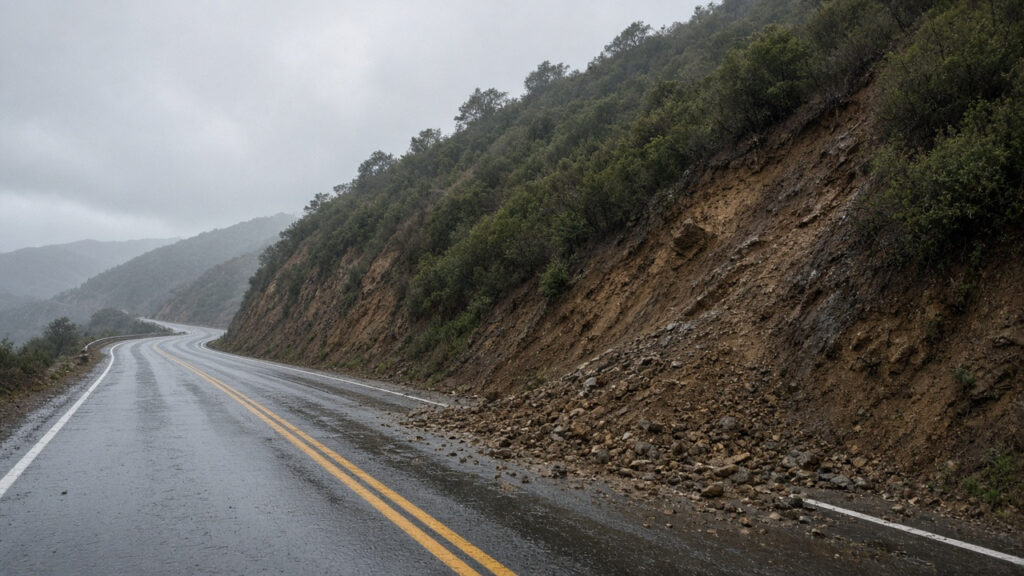
The Los Angeles Times reported on November 19, 2026, that the first atmospheric river of the season had arrived in Southern California, with concerns over debris flows and flooding, especially on fire-scarred hillsides. The National Weather Service’s Oxnard office described rainfall rates of more than an inch an hour and said those rates prompted multiple flash flood warnings. Overnight, the storm knocked over trees in San Luis Obispo and Summerland, flooded a section of Highway 101 and trapped a vehicle, and triggered multiple rock slides. The California Department of Transportation closed a section of Highway 1 in Santa Barbara County.
Los Angeles County issued evacuation warnings, in place through 8 a.m. Friday, for residents at heightened risk of mud and debris flows near recent burn scars. The Times listed those areas as including the Palisades fire near Pacific Palisades, Malibu, and Topanga; the Hurst fire near Sylmar; the Sunset fire in the Hollywood Hills; and the Eaton, Kenneth, and Canyon fire scars. The National Weather Service noted that rainfall faster than a half-inch per hour can trigger a mudflow on a hillside burned within the last couple of years. These reports describe weather, closures, and warnings. They do not, by themselves, decide fault in any crash or injury.
For how a forecast can later become evidence, see Storm Forecasts and California Injury Claims: What Weather Evidence Can Prove. For flooded freeway lanes, see Crashed on a Flooded Freeway in San Diego: Can You Claim Against Caltrans or the City?.
Why isn’t weather alone enough for a claim?
Government Code section 831 says a public entity is not liable for injuries caused by the effect of weather conditions on the use of streets and highways, and it defines weather conditions to include rain and flood. If a road was properly designed and maintained, and the only problem was that a heavy storm put water, mud, or loose rock on it, the agency is usually protected. People often call that an “act of nature” defense. The same section has important limits. It does not cover physical damage to or deterioration of a road caused by weather, such as a washed-out shoulder, a collapsed drain, or a slope that has already failed and been left unrepaired. And it does not protect an agency when the weather’s effect would not have been reasonably apparent to, and would not have been anticipated by, a person using due care.
Agencies may also argue that a slide began as a natural movement of earth on unimproved public land. Those immunities are narrow and fact-specific. They do not automatically end a claim if a dangerous condition of the road itself, or a failure to maintain or warn, played a role. Every case turns on its facts.
What does a dangerous-condition claim require?
Under Government Code section 835, a public entity can be liable for an injury caused by a dangerous condition of its property if the person shows that:
- The property was in a dangerous condition when the injury happened. Section 830 defines that as a condition creating a substantial, not minor or trivial, risk of injury when the property is used with due care in a reasonably foreseeable way.
- The dangerous condition caused the injury.
- The condition created a reasonably foreseeable risk of the kind of injury that happened.
- Either a public employee’s negligent act or omission created the condition, or the agency had actual or constructive notice of it in time to protect against it.
Notice is often the key fight. Under section 835.2, actual notice means the agency knew about the condition and knew or should have known it was dangerous. Constructive notice means the condition existed long enough, and was obvious enough, that the agency should have discovered it with reasonable care. Records that can bear on notice include prior slides at the same cut or shoulder, maintenance and inspection logs, citizen complaints, repeated closure or rock-fall reports, burn-scar debris-flow forecasts, and whether the road was left open without a warning that a careful driver would have needed. A forecast or an evacuation warning can help show what was foreseeable. It does not, by itself, prove that the agency had notice of a particular dangerous condition or enough time to close the road, post a warning, or clear debris.
Caltrans, the county, or the city?
The right agency depends on who owns or controls the exact spot where the injury happened. Caltrans generally maintains interstates and state highways, including many mountain and coastal routes. A county generally handles roads in unincorporated areas. A city generally handles its own streets. Drainage facilities, slopes, and catch basins sometimes belong to a different agency than the pavement. When ownership is unclear, a claim may need to go to more than one agency. Picking the wrong one and waiting can cost the claim. See how to file a claim against Caltrans and our government claims page.
The six-month claim deadline
Before you can sue a California public entity for personal injury, you generally must present a written claim within six months of the injury under Government Code section 911.2. If the agency rejects the claim in writing, section 945.6 generally gives six months from that notice to file suit. If you miss the six-month claim deadline, an application for leave to present a late claim under section 911.4 must be made within a reasonable time, and no later than one year after the injury. Our article on the missed six-month government claim deadline explains that process. An open investigation, a long storm, or settlement talks do not, by themselves, extend the deadline.
What weather and closure records should you save?
Preserve the forecast and warning versions that were available before the injury, including the issuing agency, publication time, valid period, and geographic coverage, plus later updates. Keep an unedited copy and the original link where possible. Then connect those records to the place and time of the injury:
- Photographs taken safely of the road, slope, debris, signs, cones, and any closure.
- The CHP, sheriff, or local police report number, and names of witnesses.
- Caltrans or county road-closure, maintenance, and inspection records for that milepost or segment, including prior slide or rock-fall reports.
- Nearby rainfall observations and, if relevant, burn-scar or debris-flow notices.
- Medical records and bills, and repair estimates if a vehicle was hit.
A distant weather station may not reflect the rainfall at the exact slope. An expert may be needed later to interpret the records and explain their limits. For a longer discussion of forecast evidence, see our storm forecast evidence article.
Talk to us
Win Attorneys handles claims against Caltrans, counties, and cities, and other injury matters, throughout California from our only office at 17291 Irvine Blvd., Suite 210, Tustin, CA 92780. We speak Spanish and Vietnamese.
Call us at (657) 235-8097, reach us through our contact page, or start online with our intake form.
This article is general information and is not legal advice. Reading it does not create an attorney-client relationship. It does not decide fault in any November 19, 2026 storm incident, and it does not report a particular injury claim.
Sources
- Los Angeles Times, “Heavy rain drenches Southern California, triggers flash flood, evacuation warnings,” November 19, 2026.
- Government Code section 831, section 830, section 835, section 835.2, section 911.2, section 911.4, and section 945.6.
Frequently asked questions
Can I claim against Caltrans or a county after a mudslide or rockslide on a California road?
Sometimes, but weather or a slide alone is usually not enough. A claim generally needs a dangerous condition of the public property, plus proof the agency created the condition or had notice and time to protect against it. Government Code section 831 often protects agencies from claims based only on the effect of weather on a road.
What is the deadline to file a claim against Caltrans or a county?
A written claim for personal injury generally must be presented within six months under Government Code section 911.2. If you miss that deadline, a late-claim application under section 911.4 has a shorter additional window, and no later than one year after the injury.
Does an ’act of nature’ automatically block a road-slide claim?
No. Agencies often rely on the weather-on-highways rule in Government Code section 831, and they may also raise other natural-condition defenses. Those rules have limits, including when weather has already damaged the road or when the danger would not have been apparent to a careful driver. The facts of the location and the agency’s notice and maintenance matter.
What records should I save after a mudslide or rockslide crash?
Keep the forecast and warning versions available before the injury, photographs of the road and debris, the police or CHP report number, witness names, medical bills, and closure or maintenance records for that stretch of road.
Do your lawyers speak Spanish or Vietnamese?
Yes. We speak Spanish and Vietnamese, and we help people statewide from our only office at 17291 Irvine Blvd., Suite 210, Tustin, CA 92780.