
Last updated
By Ron McMinn, Esq. | Last updated: November 14, 2026.
Read this article in Español.
Sometimes, but rain or flooding alone is usually not enough. California law generally protects public agencies from claims based only on the effect of weather on a road, and it names floods specifically. A claim against Caltrans, a city, or a county usually needs more: a dangerous condition of the road itself, such as a drain the agency knew was clogged, a low spot that floods storm after storm with no warning, or storm damage left unrepaired, plus proof the agency created the problem or had notice and time to fix it. And the written claim generally must be filed within six months.
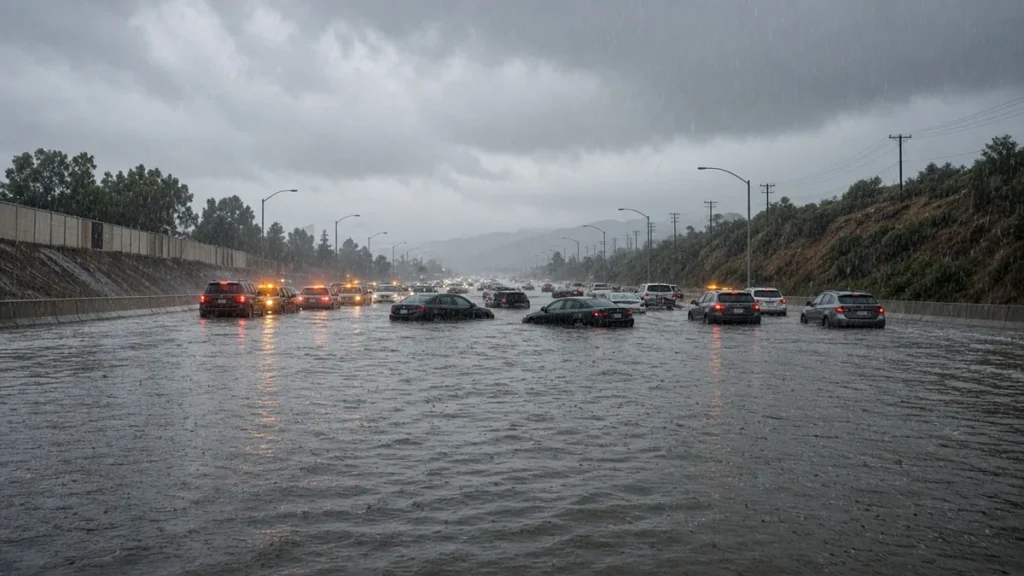
That question is practical this week. Before dawn on Friday, November 13, 2026, water covered lanes on Interstate 5 and Interstate 15 in San Diego, and forecasters expect more rounds of rain into next week. This article explains how a flooded-freeway claim works in California. It does not say that any agency is responsible for any crash.
What was reported on Friday morning?
According to Edit USA, which reviewed the CHP incident log, the CHP logged water on southbound I-5 at 4:14 a.m., on southbound I-15 near Friars Road at 4:20 a.m., and on northbound I-5 near Hawthorn Street at 4:28 a.m. A 4:31 a.m. entry reported about a foot of water in the right lane of the Hawthorn Street off-ramp, and a 4:34 a.m. entry confirmed flooding in two lanes of southbound I-5 north of Imperial Avenue. All times are Pacific.
The National Weather Service issued a flood advisory at 4:14 a.m. for western San Diego County, southeastern Orange County, and part of Riverside County, running until 6:15 a.m., Edit USA reported. An updated advisory issued at 5:17 a.m., as reported by the Sacramento Bee, warned of “minor flooding in low-lying and poor drainage areas” and “water over roadways.” NBC 7 San Diego, in an article published and updated November 13, 2026, reported that early-morning thunderstorms brought rain and lightning and caused multiple accidents and spin-outs for early drivers. NBC 7’s headline, as fetched on November 14, 2026, described “dozens of accidents.” That accident tally is NBC 7’s reporting. We did not find a second reputable outlet that independently confirmed a crash count, and we are not inventing crash locations, injury counts, or a Caltrans claim from those reports. KPBS and 10News independently confirmed the November 13 rain, advisories, and other storm effects, including beach and surf conditions and flight delays. NBC 7 also quoted National Weather Service statements, including a lightning threat for beaches, flood and high surf advisories, and a special weather statement for San Diego, Chula Vista, and Oceanside.
Elsewhere in Southern California, ABC7 Los Angeles reported that at least three cars and a semi-truck were stuck in deep water on Alameda Street near Harry Bridges Boulevard in Wilmington. The Los Angeles Fire Department said the incident was reported just before 5 a.m., and it appeared some drivers were still inside. That intersection was already the subject of a Los Angeles City Council motion, introduced October 13, 2026, asking city departments to expedite emergency repairs to address flooding there. A council committee approved an amended version on November 10, 2026. A motion like that is not a finding that the city is responsible for any crash, but it shows the kind of public record that can matter on the question of notice.
The sources we reviewed did not report injuries from these flooded roadways. We are not naming anyone involved.
Why isn’t rain alone enough for a claim?
Government Code section 831 says a public entity is not liable for injuries caused by the effect of weather conditions on the use of streets and highways, and it defines weather conditions to include rain and flood. So if a road was properly designed and maintained, and the only problem was that a heavy storm put water on it, the agency is usually protected.
The same section has two important limits. It does not cover physical damage to or deterioration of a road caused by weather, such as a washed-out shoulder or a collapsed drain. And it does not protect an agency when the weather’s effect would not be reasonably apparent to, and would not be anticipated by, a person using due care. Deep water in a dark freeway lane before dawn can raise that second question, although every case turns on its facts.
Drivers also keep their own duties. California’s basic speed law, Vehicle Code section 22350, requires a speed that is safe for the weather and the road. If another driver hit you, that driver’s insurance is often the first and most direct claim. Our guides to first-rain wet road crashes and California rain and El Niño car accidents explain how fault between drivers works in the rain. This article focuses on the public agency side.
What does a dangerous-condition claim require?
Under Government Code section 835, a public entity can be liable for an injury caused by a dangerous condition of its property if the person shows that:
- The property was in a dangerous condition when the injury happened. Section 830 defines that as a condition creating a substantial, not minor or trivial, risk of injury when the property is used with due care in a reasonably foreseeable way.
- The dangerous condition caused the injury.
- The condition created a reasonably foreseeable risk of the kind of injury that happened.
- Either a public employee’s negligent act or omission created the condition, or the agency had actual or constructive notice of it in time to protect against it.
Notice is often the key fight in a flooding case. Under section 835.2, actual notice means the agency knew about the condition and knew or should have known it was dangerous. Constructive notice means the condition existed long enough, and was obvious enough, that the agency should have discovered it with reasonable care. Records that can bear on notice include prior flooding reports at the same spot, maintenance and inspection logs for drains and pumps, citizen complaints, and repeated CHP entries for water in the same lane.
Warning signs are a separate issue. Section 830.8 generally protects agencies from claims for failing to post warning signs, but not when a warning was needed for a dangerous condition that would not be reasonably apparent to, and would not have been anticipated by, a careful driver.
Drainage design immunity, explained honestly
Agencies often raise design immunity in flooding cases. Under Government Code section 830.6, a public entity is generally not liable for an injury caused by the plan or design of a public improvement, including drainage, if the design was approved in advance by an authorized body or employee and there is substantial evidence a reasonable official could have approved it. When it applies, it is a strong defense, and it can end a case about how a freeway’s drains were sized or graded.
It is not unlimited. Design immunity covers the design, not a failure to maintain what was built. A storm drain clogged with debris, a broken pump, or an inlet left blocked after an earlier storm is usually a maintenance question, not a design question. The California Supreme Court has also recognized, in Cornette v. Department of Transportation (2001) 26 Cal.4th 63, that design immunity can be lost when changed physical conditions make an approved design dangerous and the agency had notice and a reasonable time to fix it or warn about it. Those are fact-heavy questions, and the agency usually controls the records, which is why early records requests matter.
Caltrans, the city, or the county?
The right agency depends on who owns or controls the exact spot where the crash happened:
- Caltrans (the State of California) generally maintains interstates and state highways, including their ramps. In the San Diego area, that includes I-5 and I-15. See how to file a claim against Caltrans.
- The City of San Diego generally handles city streets, including surface streets past the end of a freeway ramp. See how to file a claim against the City of San Diego.
- The County of San Diego generally handles roads in unincorporated areas. See how to file a claim against the County of San Diego.
- Other cities, such as Chula Vista or National City, handle their own streets, and some drainage facilities belong to a different agency than the road above them.
When ownership is unclear, a claim may need to go to more than one agency. Picking the wrong one and waiting can cost the claim.
The six-month claim deadline
Before you can sue a California public entity for personal injury, you generally must present a written claim within six months of the injury under Government Code section 911.2. If the agency rejects the claim in writing, section 945.6 generally gives six months from that notice to file suit. If you miss the six-month claim deadline, an application for leave to present a late claim under section 911.4 must be made within a reasonable time, and no later than one year after the injury. Our article on the missed six-month deadline explains that process. Our government claims page has more on claims against public agencies.
What evidence should you save after a flooded-road crash?
Flood evidence disappears fast. Water drains, crews clear inlets, and online logs roll over. If it is safe, and only if it is safe:
- Photograph and video the water, its depth against your tires or a curb, the lane it covered, nearby drain inlets, and any warning signs or the lack of them. Get a wide shot that shows mile markers, exit signs, or call boxes.
- Write down the exact location, direction of travel, lane, and time.
- Ask for the CHP incident or report number, and screenshot the CHP traffic incident page entry while it is still listed.
- Screenshot Caltrans QuickMap and 511 San Diego alerts, with the time showing.
- Save the National Weather Service advisory text and time, and any alert that came to your phone.
- Keep dash camera video, tow and repair records, and the names of witnesses and first responders.
- Get medical care and keep every record and bill.
- Through counsel, request the agency’s maintenance, inspection, and complaint records for that location under the California Public Records Act, Government Code section 7920.000 and following.
Our earlier article on storm forecasts and injury claim evidence covers building a weather timeline. This article adds the public-road steps that matter after an actual flooded-freeway crash.
Before the next storms
ABC 10News forecast another round of showers overnight Friday into Saturday, a third storm Monday into Tuesday, and a fourth as early as Wednesday night with scattered showers Thursday. The National Weather Service’s advice in Friday’s advisory was simple: turn around, don’t drown, and be especially careful at night, when flooding is harder to see. If you are hurt anyway, document what you can and keep the six-month clock in mind.
Talk to us
Win Attorneys handles claims against Caltrans, cities, and counties throughout California from our Tustin office. We speak Spanish and Vietnamese. We do not represent anyone involved in the flooding described above.
Call us at (657) 235-8097, reach us through our contact page, or start online with our intake form. Office: 17291 Irvine Blvd., Suite 210, Tustin, CA 92780.
This article is general information and is not legal advice. Reading it does not create an attorney-client relationship. Reports about the November 13, 2026 flooding were preliminary when this was written.
Sources
- Edit USA, “Flooding reported on I-5 and I-15 in San Diego during Friday morning advisory,” November 13, 2026 (citing the CHP incident log and the National Weather Service).
- Sacramento Bee, flood advisory update, November 13, 2026.
- NBC 7 San Diego, November 13, 2026 (published and updated November 13, 2026; fetched November 14, 2026). The page title as fetched was “San Diego thunderstorms cause dozens of accidents in early morning.” The accident and spin-out reporting, including that headline tally, is attributed to NBC 7 only.
- KPBS, “Rain moves into San Diego area; advisory issued for local beaches, bays,” November 13, 2026 (storm, rain, and beach advisory confirmation; not a crash count).
- 10News, “Friday’s wet weather causes flight delays, impacts events around the San Diego area,” November 13, 2026 (storm effects, including flight delays; not a crash count).
- ABC7 Los Angeles, “Several cars stuck on flooded street in Wilmington area,” November 13, 2026.
- Los Angeles City Council File 25-0712-S1.
- ABC 10News, San Diego weather forecast for November 12, 2026.
Frequently asked questions
Can I sue Caltrans if I crashed on a flooded freeway?
Possibly, but not just because it rained. Government Code section 831 generally protects public agencies from claims based on the effect of weather, including floods, on a road. A claim usually needs a dangerous condition of the road itself, such as a drain the agency knew was clogged or storm damage left unrepaired, plus proof the agency created the problem or had notice and time to fix it.
What is the deadline to file a claim against Caltrans or the City of San Diego?
A written claim for personal injury generally must be presented within six months of the injury under Government Code section 911.2. If the claim is rejected in writing, a lawsuit generally must follow within six months of that notice. A late claim application must be made within a reasonable time and no later than one year after the injury.
Does design immunity always block a flooding claim?
No. Design immunity under Government Code section 830.6 can protect an approved drainage or road design, but it does not cover poor maintenance, such as a clogged inlet or a broken pump. The California Supreme Court has also recognized that design immunity can be lost when changed physical conditions make a design dangerous and the agency had notice and time to fix it or warn drivers.
Who is responsible for flooding on a freeway off-ramp in San Diego?
Interstates and their ramps are generally maintained by Caltrans. Surface streets past the end of the ramp are usually the city’s responsibility, and roads in unincorporated areas are usually the county’s. Ownership of the exact spot, including the drains, decides which agency gets the claim.
What evidence helps prove a flooded-road claim?
Photos and video of the water depth and drains, the exact location and time, the CHP incident number, screenshots of Caltrans QuickMap and 511 alerts, the National Weather Service advisory, dash camera video, witnesses, and medical records. Agency maintenance and complaint records for the location can also be requested under the Public Records Act.
If another driver hit me on a flooded freeway, who pays?
Usually that driver’s insurance comes first. California’s basic speed law requires a speed that is safe for weather and road conditions, and fault can be shared among several drivers. A public agency claim is a separate question and may exist alongside a claim against a driver.
Did the November 13 thunderstorms cause dozens of accidents in San Diego?
NBC 7 San Diego reported that early-morning thunderstorms caused multiple accidents and spin-outs, and its headline referred to dozens of accidents. That accident tally is NBC 7’s reporting. KPBS and 10News confirmed the rain and other storm effects, not a crash count. We are not inventing crash locations, injuries, or a Caltrans claim from those reports.
Do your lawyers speak Spanish or Vietnamese?
Yes. We speak Spanish and Vietnamese, and we help people statewide from our office at 17291 Irvine Blvd., Suite 210, Tustin, CA 92780.