
Last updated
By Ron McMinn, Esq. | Last updated: November 22, 2026
On Sunday evening, November 22, 2026, an Amtrak passenger train struck a tractor-trailer hauling a bulldozer at a railroad crossing in Lafayette, Louisiana, and the first two train cars derailed. The crash was not in California. It still matters here, because the only Amtrak passenger service through Lafayette is the Sunset Limited, the long-distance train that runs between Los Angeles and New Orleans and stops in Southern California. This guide explains, in general terms, what California riders should know after a crash like this, and what the rules look like if a similar truck-and-train collision happened at a California crossing. The cause of the Lafayette crash is under investigation, and we do not assign fault.
What was reported about the Lafayette crash?
The Lafayette Police Department told local news outlets that the collision happened at about 6:05 p.m. Central Time (4:05 p.m. Pacific Time) on Sunday, November 22, 2026, in the 100 block of Thru-Way Park Road, along U.S. 90, near Broussard. According to those accounts, an Amtrak passenger train struck an 18-wheeler that was hauling a bulldozer, and the first two cars of the train left the tracks.
KLFY reported that the train was carrying approximately 95 passengers. KLFY, citing sources, also said twelve ambulances were sent to the scene and that four people were taken to hospitals with injuries believed to be non-life-threatening, with additional transports possible. The Advocate, also citing Lafayette police, reported one minor injury at the time of its account. Acadiana News First similarly described the reported injuries as minor. Those early counts do not agree, and the figures may change as the investigation continues.
News outlets have also given conflicting descriptions of the crossing itself. KLFY called it uncontrolled. The Advocate called it a controlled crossing. Acadiana News First described a crossing with a functioning arm. Investigators have not issued a public finding on that point, and we take no position on it.
Local accounts have identified the train as Amtrak. They have not, in the reports we reviewed, named the route. Lafayette is a scheduled stop on Amtrak’s Sunset Limited, and that is the only Amtrak passenger service there. Amtrak’s published timetable lists an eastbound Sunday arrival in Lafayette at 5:15 p.m. As of the evening of November 22, 2026, we had not seen an official Amtrak statement about the crash. We are not stating a train number or a direction of travel.
This article does not name anyone involved, and it does not say who was at fault.
Why this matters for California Amtrak riders
The Sunset Limited is Amtrak’s southern long-distance route between New Orleans and Los Angeles. Amtrak lists California stops at Los Angeles Union Station, Pomona, Ontario, and Palm Springs. Californians board that train, connect to it, and ride other Amtrak routes that use the same kinds of grade crossings. A truck-and-train collision that derails passenger cars is the kind of crash that also happens in this state. We wrote earlier about a Pacific Surfliner collision with a vehicle in Carlsbad and about a crossing crash in Colton. Those are different incidents. The legal questions, though, will sound familiar to anyone who rides Amtrak in California.
Our Amtrak accident page and our guide to train and rail crossing injuries in California explain the broader framework.
If you were hurt on a long-distance Amtrak train outside California
A crash in another state does not automatically bring California law into play. The law of the place where the collision occurred often matters a great deal, including duties, comparative fault, and the time to sue. Federal law can matter too, because Amtrak is a federally chartered corporation. Under 49 U.S.C. section 24301, Amtrak is operated and managed as a for-profit corporation and is not a department, agency, or instrumentality of the United States Government. Which court may hear a case, and which deadline applies, depends on the facts, including where the passenger lives, where the ticket was bought, and where the railroad and any trucking company can be sued. Do not assume that California’s two-year personal-injury deadline controls a crash that happened in Louisiana.
Two federal points still come up often for Amtrak passengers, wherever the train was at the time:
- Amtrak’s status. Because Amtrak is not a government agency under 49 U.S.C. section 24301, California’s six-month government-claim rule generally does not apply to a claim against Amtrak alone. That is the usual rule in a California Amtrak case. It is not a shortcut around whatever deadline applies to an out-of-state crash.
- The passenger-rail cap. Federal law, 49 U.S.C. section 28103, sets an aggregate limit on recoveries from a single passenger rail accident, against all defendants, including punitive damages. The U.S. Department of Transportation adjusts that figure. The cap rarely matters in a single-injury case, but it can matter when many people are hurt in one accident. Our Amtrak accident page explains how that limit works.
Amtrak’s published ticket terms have also included a mutual arbitration agreement that can reach personal injury claims. Whether it applies depends on the booking and the terms in effect for that ticket. Keep your eTicket and reservation emails. Our guide to how to file an Amtrak injury claim in California walks through reporting, records, and the usual California deadlines, and it explains why a customer-service complaint is not, by itself, a substitute for a timely legal claim.
If a truck and an Amtrak train collided at a California crossing
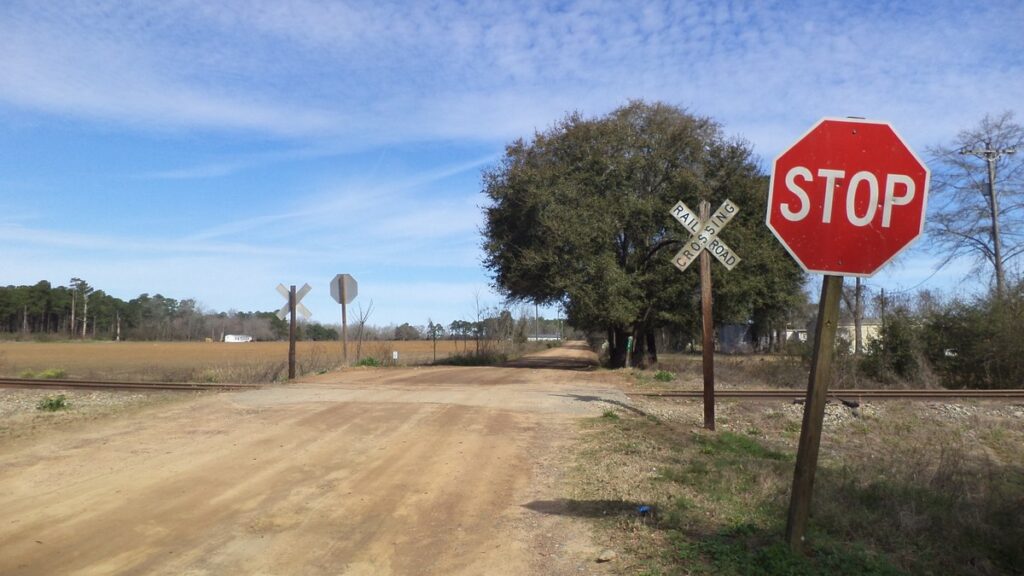
If a collision like this one happened at a crossing in California, more than one party may be involved, and the facts of the crossing control the analysis. In general terms, these are the kinds of parties that can come up:
- Amtrak. Amtrak operated the train. In California, a carrier of persons for reward must use the utmost care and diligence for their safe carriage under Civil Code section 2100. That is a high standard. It does not make Amtrak responsible for every injury, and it is a California rule. It does not, by itself, decide a crash in another state.
- The railroad that owns or maintains the track or crossing. Lights, bells, gates, and the crossing surface may belong to, or be maintained by, someone other than the railroad that ran the train. Ownership and maintenance records should be identified early.
- The trucking company and the driver. A tractor-trailer, especially one hauling heavy equipment, raises questions about whether the truck could clear the crossing, whether it was moving or stopped, and how the load was secured. Those are evidence questions. Our truck accident page explains the broader framework for commercial-truck claims in California. We do not say what happened in Lafayette.
- A city, county, or state agency. A public agency may control the road, the approaches, sight lines, or warning devices tied to the crossing. A written claim against a California public entity generally must be presented within six months under Government Code section 911.2.
None of those possibilities is a finding about the Lafayette crash. A lawsuit against Amtrak for a California injury is usually subject to the two-year deadline in Code of Civil Procedure section 335.1. If a public agency may share responsibility, calendaring the six-month period is the safer course. Do not wait for a police investigation to finish before those dates are on the calendar.
What to do after an Amtrak derailment or crossing crash
Get medical care first, then protect the evidence and the deadlines. Here is a simple order.
- Get medical care. Tell the providers how the injuries happened, and keep every record and bill.
- Ask that a report be made. Tell the conductor or other crew, and write down the train number, car number, date, time, and direction. If needed, Amtrak Police can be reached at 1-800-331-0008, by texting APD11 (27311), or by calling 911, according to Amtrak’s Police Department page.
- Save your ticket and reservation emails. Those records can show the train, the route, and which ticket terms applied.
- Photograph what you safely can. Capture injuries, the car you were in if you can do so safely, and, at a crossing, signs, signals, gates, and sight lines.
- Ask that video and signal records be kept. Event recorders, crossing-warning logs, and nearby cameras can be overwritten. A short written request can matter.
- Be careful with recorded statements or signed releases before you understand your rights.
- Calendar every deadline that may apply. For a California crash, treat six months as the outer limit for any public-entity claim. For a crash in another state, do not assume California’s deadlines control.
Talk to us
If you or someone you love was hurt in a collision involving an Amtrak train, we are here to listen and to explain your options. Win Attorneys represents injured people throughout California. Talk to us at (657) 235-8097. We speak Spanish and Vietnamese.
Hablamos español. Chúng tôi nói tiếng Việt.
Office
Win Attorneys
17291 Irvine Blvd., Suite 210, Tustin, CA 92780
This article is general information and is not legal advice. Reading it does not create an attorney-client relationship. The Lafayette crash remains under investigation, and this article does not assign fault. It is not a statement of Louisiana law.
Sources: KLFY, November 22, 2026, The Advocate, November 22, 2026, Acadiana News First, November 22, 2026, Amtrak, Sunset Limited, Amtrak Sunset Limited timetable, 49 U.S.C. section 24301, 49 U.S.C. section 28103, Civil Code section 2100, Government Code section 911.2, Code of Civil Procedure section 335.1.
Frequently asked questions
Does California law apply if an Amtrak crash happens in another state?
Not automatically. The law of the state where the crash occurred often plays a large role, and federal law can also apply because Amtrak is a federally chartered corporation. Which court may hear a case, and which deadline controls, depends on the facts. This article explains California and federal rules that often matter for California riders. It is not a statement of Louisiana law.
Who may be responsible when an Amtrak train hits a truck at a crossing?
It depends on the evidence. Parties that can come up include Amtrak, the railroad that owns or maintains the track or crossing, the trucking company and driver, and a public agency that controls the road or warning devices. A news report is not a finding of fault.
How long do I have to make a claim after an Amtrak injury in California?
A lawsuit against Amtrak itself is usually subject to a two-year deadline under Code of Civil Procedure section 335.1. If a California public entity may also be involved, a written government claim is generally due within six months. For a crash outside California, do not assume those same periods control. Calendar every deadline that may apply.
Does the federal passenger rail cap apply to a crash like this?
Federal law sets an aggregate limit on recoveries from a single passenger rail accident, against all defendants, including punitive damages. The U.S. Department of Transportation adjusts the figure. The cap rarely matters in a single-injury case, but it can matter when many people are hurt in one accident. Our Amtrak accident page explains how that limit works.
What should I do if I was a passenger on a long-distance Amtrak train that derailed?
Get medical care first. Ask that a report be made, and write down the train number, car number, date, time, and direction. Save your ticket and reservation emails. Photograph what you safely can. Be careful with recorded statements or signed releases before you understand your rights. Our guide to filing an Amtrak claim walks through the next steps.
Do you speak Spanish or Vietnamese?
Yes. We speak Spanish and Vietnamese. Talk to us at (657) 235-8097. Our only office is at 17291 Irvine Blvd., Suite 210, Tustin, CA 92780.