
Last updated
By Ron McMinn, Esq. | Last updated: November 13, 2026.
Read this article in Español or in Tiếng Việt.
If you are hurt on a California freeway shoulder, the other driver’s liability insurance is usually the first place to look. Your own uninsured or underinsured motorist coverage can matter if that insurance is missing or too small. A claim against a city or Caltrans is a different question, and only the facts can support it. We do not assign fault here.
This article uses a crash reported on November 13, 2026, in the City of Orange, only as context for how those claims work. The injury outcome was not reported.
What was reported?
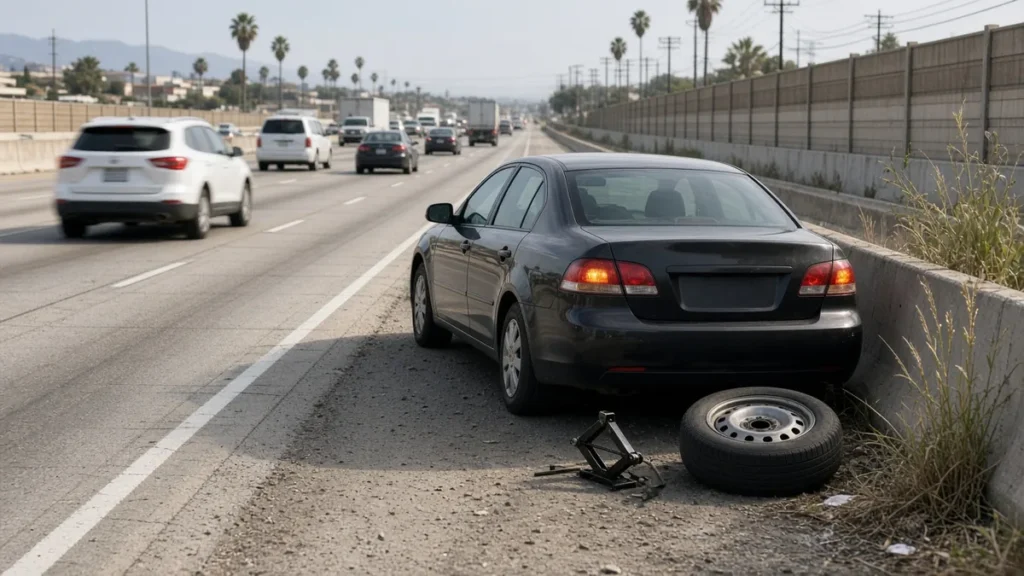
Orange County Patch, citing the California Highway Patrol, reported that a man was hit by a truck on the right shoulder of northbound Interstate 5 near State College Boulevard at about 11:25 a.m. on Friday, November 13, 2026. According to the article, the crash was reported at 11:25 a.m., the vehicle that hit him was a Chevrolet Silverado, and he was possibly changing a tire on the right shoulder. The status of the injured pedestrian was not immediately known. The article said the crash slowed northbound traffic.
We are not naming anyone. “Possibly changing a tire” is the wording the article used. It is not a finding about what happened, and it is not a finding of fault. We do not know the person’s injuries, and we are not inventing an outcome.
Who may pay after a shoulder crash?
In a typical case, the driver who hits a person on the shoulder can be responsible for careless driving, and that driver’s auto liability policy is often the first source of payment. California’s minimum liability limits for policies issued or renewed since 2025 are 30,000 dollars for injury to one person, 60,000 dollars for injury to more than one person in one crash, and 15,000 dollars for property damage. Those minimums are often too small for a serious injury. See our article on the 30, 60, 15 minimum limits.
The owner of the Silverado may also have responsibility if someone else was driving, up to the limits in Vehicle Code section 17151. If the driver had little or no insurance, your own uninsured or underinsured motorist coverage, if you have it, can be an important source of payment. Medical payments coverage on your own policy, if it exists, may help with early bills regardless of fault. See our pages on UM and UIM claims and med-pay benefits.
A Chevrolet Silverado is a pickup truck. It is not, by itself, a commercial big rig. If the driver was working at the time, the employer or a company policy may also be in the picture. That depends on facts that the Patch report does not give.
Does being on the shoulder, possibly changing a tire, end the claim?
No. California uses comparative fault. Under that rule, a recovery can be reduced by a person’s own share of fault, but it is not automatically barred. An insurer may argue that someone on the shoulder should have done more to stay visible or out of the way. Those arguments have to be tested against the evidence: lighting, weather, where the vehicles were, whether hazard lights or cones were out, how the moving vehicle was driven, and what a reasonable driver should have seen in time to avoid a person on the shoulder.
The November 13 report said the person was possibly changing a tire. That possibility should be stated as a possibility, nothing more, until the CHP report and other evidence are in. This is not the same fact pattern as our guide to being hurt while stopped to help a disabled car when a big rig hits you, or our guide to a crash into a big rig already parked on the shoulder. Those pages are useful background. They do not decide this crash.
Is this a City of Orange or Caltrans claim?
Not automatically. Interstate 5 is generally a state freeway, which points to Caltrans, not the City of Orange, for the roadway itself. A claim against Caltrans or a city for a dangerous condition of public property is possible only in the right facts, under Government Code section 835. The Patch report does not describe a road defect, a missing warning, or a public vehicle. Do not assume a government claim is required, and do not assume one is unavailable, without looking at the evidence.
If a public entity is involved, a written government claim is generally due within six months under Government Code section 911.2. For how those claims are filed, see our guides on how to file a claim against Caltrans and how to file a claim against the City of Orange. Our Orange location page explains how we serve clients in the City of Orange from our Tustin office.
What should you save?
- Get medical care and keep every record and bill.
- Ask the CHP for the collision report number. Our guide to how to get a California crash report explains the request process.
- Photograph the shoulder, your vehicle if it was there, signs, lighting, and your injuries, if you can do so safely or if someone can do it for you.
- Write down what you remember about hazard lights, cones, traffic, weather, and the other vehicle, including the license plate and any company markings.
- Save dash camera or phone video right away, before it is overwritten.
- Be careful giving a recorded statement to the other driver’s insurer before you understand your rights.
What are the deadlines?
Most California injury lawsuits must be filed within two years under Code of Civil Procedure section 335.1. If a public entity is involved, the six-month government claim rule generally comes first. Insurance policies also have their own notice periods. Do not wait for a final CHP report before protecting a claim.
Talk to us
Win Attorneys helps people hurt in California crashes from our only office, in Tustin. We speak Spanish and Vietnamese. Loc Nguyen and Jimmy Nguyen of Win Attorneys work with clients and families in Vietnamese. We do not represent anyone described in the November 13 report, and nothing here is a comment on any pending investigation.
Call us at (657) 235-8097, reach us through our contact page, or start online with our intake form. Office: 17291 Irvine Blvd., Suite 210, Tustin, CA 92780.
This article is general information and is not legal advice. Reading it does not create an attorney-client relationship. Every case depends on its own facts.
Sources
Frequently asked questions
Who pays if I am hit on a freeway shoulder in California?
The driver who hits you is usually the first person responsible, and that driver’s auto liability insurance is often the first source of payment. The vehicle owner, an employer, and your own uninsured or underinsured motorist coverage may also be in the picture, depending on the facts.
The news said the person was possibly changing a tire. Does that end a claim?
No. Orange County Patch, citing the CHP, used the word possibly. That is not a finding of what happened, and it is not a finding of fault. California uses comparative fault, so a recovery can be reduced, not automatically barred, if an injured person’s own conduct is found to share fault.
Do I need to file a claim against the City of Orange?
Not automatically. The reported crash was on Interstate 5, which is generally a state freeway. A City or Caltrans claim matters only if the facts show a dangerous road condition or a public vehicle. The November 13 report does not describe those facts.
The injury status was not reported. Can I still ask about a claim?
Yes. The Patch article said the status of the injured pedestrian was not immediately known. We are not inventing an outcome. If you or a family member was hurt, medical records and the CHP report, when it is available, will matter more than the first news story.
How long do I have to make a claim?
Most injury lawsuits in California must be filed within two years under Code of Civil Procedure section 335.1. If a public entity is involved, a written government claim is generally due within six months. It is better not to wait for the final crash report before getting advice.
Do your lawyers speak Spanish or Vietnamese?
Yes. We speak Spanish and Vietnamese, and Loc Nguyen and Jimmy Nguyen of Win Attorneys work with clients and families in Vietnamese. Our only office is at 17291 Irvine Blvd., Suite 210, Tustin, CA 92780.