
Last updated · Reviewed by Ron McMinn, Esq.
You can sue Metro over a bus crash only if Metro or its employee shared in causing the harm, such as through the operator’s conduct or bus maintenance. Otherwise the claim usually goes against the other driver and that driver’s insurer. Against a public entity such as Metro, a written claim generally must be presented within six months.
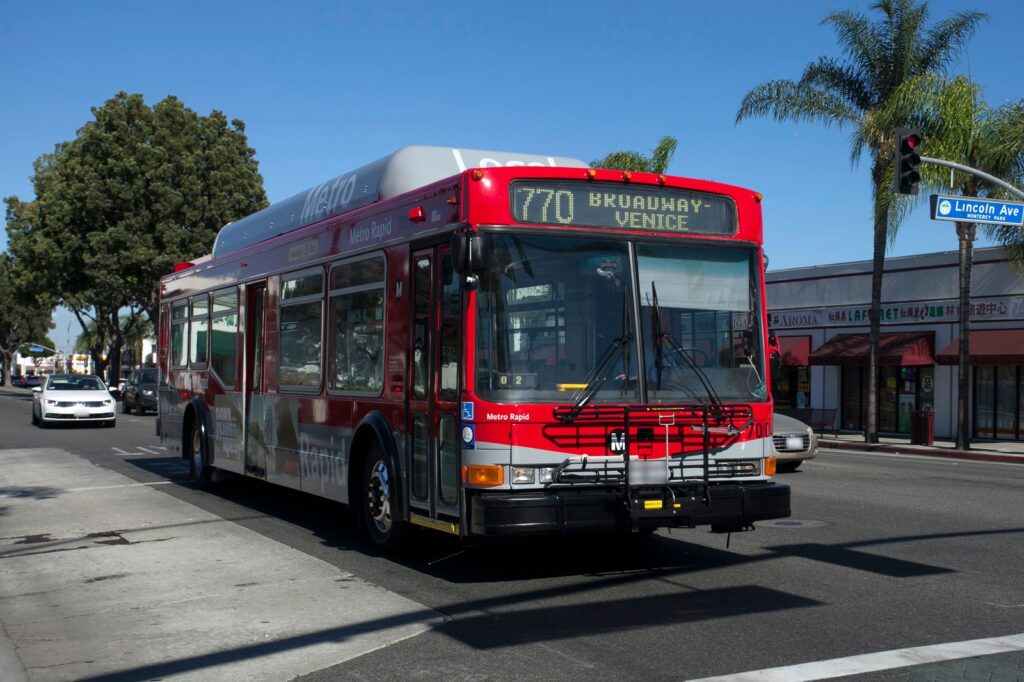
Early on Monday, October 26, 2026, at about 2:30 a.m., a car ran a red light and collided with a Metro bus on Line 60 at Sixth and Hill streets in downtown Los Angeles, according to MyNewsLA and The Eastsider, both carrying City News Service reporting that cites Metro. The bus was traveling eastbound on Sixth Street. In a statement, Metro said a person in the other car was taken to a local hospital with non-life-threatening injuries.
We are glad the reported injuries were not life-threatening, and we wish the person who was hurt a full recovery. The crash raises a question many Los Angeles riders and drivers share: when a Metro bus accident involves another vehicle, who pays? Our bus accident lawyers and our guide to LA Metro accidents explain the details, and this article walks through the general rules. The crash is the news hook; the law described here is California law.
What Is Known and Not Known About the Sixth and Hill Crash
The reports do not say who was driving any vehicle, whether anyone was aboard the bus, whether anyone was cited, or whether any driver was insured. Investigators have not announced findings, and we assign no fault to anyone. Those missing details drive every question below, so treat this article as a map and not as a conclusion about this crash.
Start With the Other Driver’s Liability Insurance
In most crashes, the first claim is against the driver whose negligence is alleged to have caused the collision, and against that driver’s liability insurer. Under Vehicle Code section 16056, the state’s minimum liability limits for bodily injury on policies issued or renewed on or after January 1, 2025 are $30,000 for one person and $60,000 for two or more people in one accident. Those figures are floors and can fall short when several people need hospital care. Evidence decides these claims: police and Metro reports, signal timing, video and witness statements.
If the Other Driver Is Uninsured or Underinsured
California auto liability policies must include uninsured motorist coverage unless the policyholder rejects or reduces it in writing, under Insurance Code section 11580.2. Underinsured coverage can apply when the at-fault driver’s limits are exhausted and your damages are higher. The statute protects the named insured, certain relatives in the household, and other people in or entering an insured vehicle. If the driver cannot be identified, it sets extra requirements, including physical contact with the insured’s vehicle and a police report within 24 hours. A UM claim also has its own two-year timing rule. Our UM and UIM claims page covers the steps.
One limit is worth knowing: the statute’s definition of an uninsured vehicle excludes vehicles owned by a government agency. So UM coverage is not the route for a claim based on the bus itself.
When Can You Claim Against Metro?
A transit agency is not automatically responsible for every crash involving its bus. Under Government Code section 815.2, a public entity can be liable for an injury proximately caused by an employee’s act or omission within the scope of the job, if the act would support a claim against the employee. If a bus operator’s conduct, a maintenance failure or another Metro decision played a part, a claim against Metro may be appropriate. If the bus was simply struck, responsibility may rest with the other driver, and an accurate claim says so.
Passengers have one more tool. Civil Code section 2100 requires a carrier of persons for reward to use the utmost care and diligence for their safe carriage. That duty is about what the carrier itself did or failed to do, and we look at how it applies to a public agency on the facts. It does not by itself shift another driver’s negligence onto the carrier. Our post on being injured on a Metro bus by another driver goes deeper on passenger claims.
The Six-Month Claim Deadline
Before suing a public entity such as Metro for injury, you generally must present a written claim within six months, under Government Code section 911.2. Counting six months from October 26, 2026 points to April 26, 2027, but exact counting can be disputed, so do not wait for the last day. If the deadline is missed, section 911.4 allows a written application to present a late claim, within a reasonable time not to exceed one year after the claim accrued, and acceptance is not guaranteed. After a rejection, section 945.6 generally gives six months to file suit when the notice was given as the statute requires. See our government claims page for the process.
That deadline applies to claims against the public entity. A claim against a private driver follows the usual two-year injury deadline in Code of Civil Procedure section 335.1.
For the filing steps and what changes when a private contractor ran the bus or it was a DASH or Big Blue Bus, see Hurt by an LA Metro Bus? How to File a Claim and Who Gets It in California.
Medical Payments Coverage and Other Ways Bills Get Paid
Medical payments coverage, often called med-pay, is an optional part of an auto policy that can help with medical bills after a crash whatever the fault, up to the limit on the policy. Whether you have it is on your declarations page, and our med-pay guide explains how it works. Keep every bill and explanation of benefits, because payers may seek repayment later.
Shared Fault When More Than One Vehicle Is Involved
California uses pure comparative fault. In Li v. Yellow Cab Co. (1975) 13 Cal.3d 804, the California Supreme Court held that a person’s own share of fault reduces damages but does not bar recovery. Under Civil Code section 1431.2, each defendant’s liability for non-economic damages is limited to its own percentage of fault. With two cars and a bus, those percentages can change what each insurer pays.
What to Do After a Crash Involving a Bus
- Get medical care. Tell providers you were in a bus collision.
- Note the bus details. Write down the line number, bus number, time and place.
- Request the reports. Ask for the police report number and any Metro incident number.
- Save evidence. Keep photos, video and witness names.
Frequently Asked Questions
Can I sue Metro if a car hit the bus I was riding?
Only if Metro or its employee shared in causing the harm, such as through the operator’s conduct or bus maintenance. Otherwise the claim usually goes against the other driver and that driver’s insurer.
What if the other driver has no insurance?
Your own uninsured motorist coverage may apply, and underinsured coverage can apply when the other driver’s limits are too low.
Does medical payments coverage pay if the crash was not my fault?
Medical payments coverage is designed to help with medical bills whatever the fault, up to the limit you bought.
How long do I have to bring a claim after a crash involving a bus?
Against a public entity such as Metro, a written claim generally must be presented within six months. Against a private driver, the usual injury deadline is two years.
Talk to us
If you or someone you love was hurt on a Los Angeles bus or in a car hit by one, we can explain your options and the deadlines that apply, without pressure. If the injury happened on a Metro rail line or a Metrolink train instead, start with our page for a Los Angeles train accident attorney. We help clients statewide across California, including downtown Los Angeles and the surrounding area, and our team speaks Spanish and Vietnamese. See our Los Angeles page for local information, visit Win Attorneys at 17291 Irvine Blvd., Suite 210, Tustin, CA 92780, or call us at (562) 296-5380.
This article is general information for educational purposes. It is not legal advice and does not create an attorney-client relationship. Crash details are from MyNewsLA and The Eastsider (City News Service), citing Metro, as of October 28, 2026, and may change as the investigation continues. No fault is assigned to anyone. Outcomes depend on the facts of each matter.