
Last updated
By Ron McMinn, Esq. | Official sources checked November 12, 2026.
Read this article in Español.
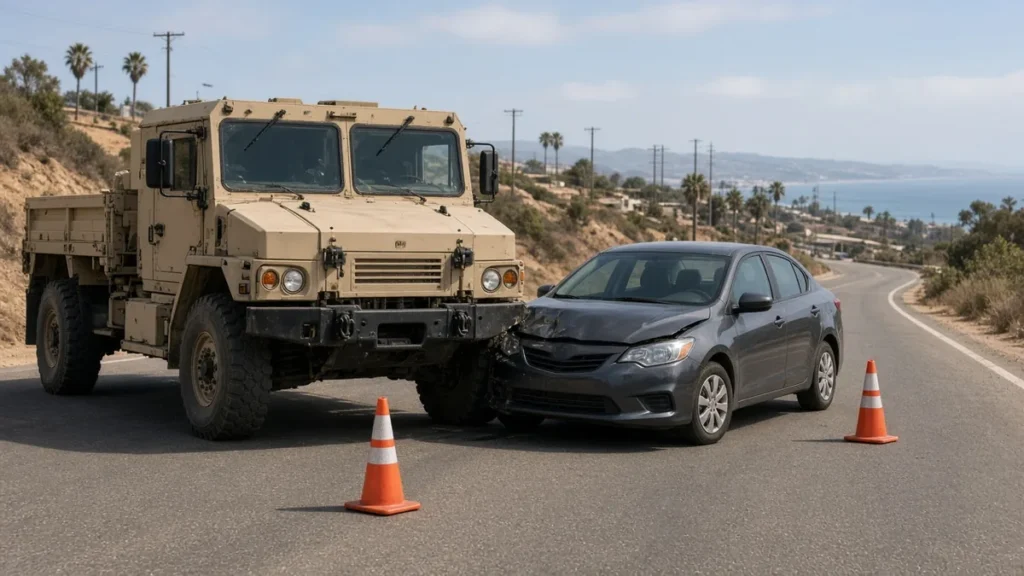
San Diego County has a large military and federal presence, so crashes with government vehicles happen on its freeways and city streets. When the vehicle belongs to the United States, the usual California rules for claims against a city or county do not apply. The claim goes through the Federal Tort Claims Act (FTCA), which has its own form, its own deadlines, and its own traps. The same rules apply anywhere in California.
Short answer: If a federal employee or service member acting within the scope of their job caused the crash, you generally must first present a written claim to the responsible federal agency, usually on Standard Form 95, stating a specific dollar amount, within two years. You can sue in federal court only after the agency denies the claim or six months pass without a final decision.
Is it a federal claim?
Under 28 U.S.C. section 2671, an “employee of the government” includes officers and employees of federal agencies and members of the military or naval forces. For service members, acting within the scope of employment means acting in line of duty. The same section says a “federal agency” does not include a contractor with the United States.
- Federal employee or service member on duty. The claim is against the United States, and section 2679(b)(1) makes that the exclusive remedy instead of suing the driver personally.
- Private contractor. If the driver worked for a private company doing government work, the FTCA generally does not apply, and an ordinary claim against the company and its insurer may be the path. Vehicle markings do not always tell you which one it is.
- Off duty in a personal car. A service member driving their own car on personal business is usually handled like any other driver, through their auto insurance.
A city, county, or State vehicle is different again. Those claims usually must be presented within six months under California law. See our government claims page.
Presenting the claim
Under 28 U.S.C. section 2675(a), a lawsuit cannot start until the claim has been presented to the appropriate federal agency and finally denied in writing. If the agency does not make a final decision within six months, the claimant may treat that as a denial.
Under 28 C.F.R. section 14.2, a claim is presented when the agency receives an executed Standard Form 95 or other written notice of the incident with a claim for money damages in a sum certain. It should go to the agency whose activities gave rise to the claim, and it may be amended before the agency takes final action.
The amount you claim matters
A claim with no specific dollar amount may not count as presented. And under section 2675(b), a later lawsuit generally cannot ask for more than the amount in the claim, unless the increase is based on newly discovered evidence or intervening facts. Before filing, it helps to understand the medical picture, including future care, so the number is not set too low.
Deadlines
Under 28 U.S.C. section 2401(b), a tort claim against the United States is barred unless it is presented in writing to the federal agency within two years after it accrues, and suit is filed within six months after the agency mails its notice of final denial.
How federal cases differ
- Judge, not jury. FTCA cases are tried by the court without a jury (section 2402).
- Damages. The United States is liable in the same manner as a private person under like circumstances, but not for interest before judgment or punitive damages (section 2674).
- Attorney fees. Fees are capped at 20 percent of an administrative settlement and 25 percent of a judgment or settlement after suit (section 2678).
- Service members. Under Feres v. United States (1950) 340 U.S. 135, the government is not liable under the FTCA for injuries to service members that arise out of activity incident to service. Other benefits may apply instead.
What to save
- Photos of the vehicle, including any unit markings, plates, and numbers.
- The driver’s name and agency, and the police or military police report number.
- Witness contacts, medical records, and repair estimates.
Your own auto policy, including uninsured and underinsured motorist coverage, may also matter. See what happens when a police car hits a pedestrian for how city vehicle claims compare.
Talk to us
Win Attorneys handles personal injury and government claims matters statewide from our only office in Tustin. We speak Spanish and Vietnamese.
Call us at (657) 235-8097, write through our contact page, or start online with our intake form. Office: 17291 Irvine Blvd., Suite 210, Tustin, CA 92780.
Sources
- 28 U.S.C. section 2401, section 2402, section 2671, section 2674, section 2675, section 2678, and section 2679 (Cornell Legal Information Institute).
- 28 C.F.R. section 14.2 (eCFR).
- U.S. General Services Administration, Standard Form 95, Claim for Damage, Injury, or Death.
- Feres v. United States (1950) 340 U.S. 135.
Frequently asked questions
How do I file a claim after a crash with a military vehicle?
If the driver was a service member or federal employee acting within the scope of their job, you generally present a written claim to the responsible federal agency, usually on Standard Form 95, stating a specific dollar amount.
How long do I have to file an FTCA claim?
Under 28 U.S.C. section 2401(b), the written claim must be presented to the federal agency within two years after it accrues. A lawsuit must follow within six months after the agency mails a final denial.
Can I sue the federal driver personally?
Generally no. When a federal employee acts within the scope of employment, 28 U.S.C. section 2679(b)(1) makes the claim against the United States the exclusive remedy.
Why does the amount on Standard Form 95 matter?
A claim needs a sum certain to count as presented, and under 28 U.S.C. section 2675(b) a later lawsuit generally cannot ask for more than that amount without newly discovered evidence or intervening facts.
What if the agency does not answer?
If the agency makes no final decision within six months after the claim is filed, the claimant may treat that as a denial and file suit, under 28 U.S.C. section 2675(a).
Is there a jury in an FTCA case?
No. Under 28 U.S.C. section 2402, FTCA cases against the United States are tried by a judge without a jury.
Can I talk to a lawyer in Spanish or Vietnamese?
Yes. We speak Spanish and Vietnamese. Call (657) 235-8097. Our only office is at 17291 Irvine Blvd., Suite 210, Tustin, CA 92780.
This article is general information and is not legal advice. Reading it does not create an attorney-client relationship. Every case depends on its own facts.