
Last updated
By Ron McMinn, Esq. | Last updated November 18, 2026.
Read this article in Español or Tiếng Việt.
If a driverless car stops on trolley tracks in California, the hard questions are who may have to pay, how quickly a claim against a transit agency must be presented, and what evidence can disappear. This article uses a reported November 2026 incident in San Diego to explain those rules. It does not decide fault. No official findings have been released.
Win Attorneys handles robotaxi, trolley, and other injury claims throughout California from our only office in Tustin. We speak Spanish and Vietnamese.
What news reports described
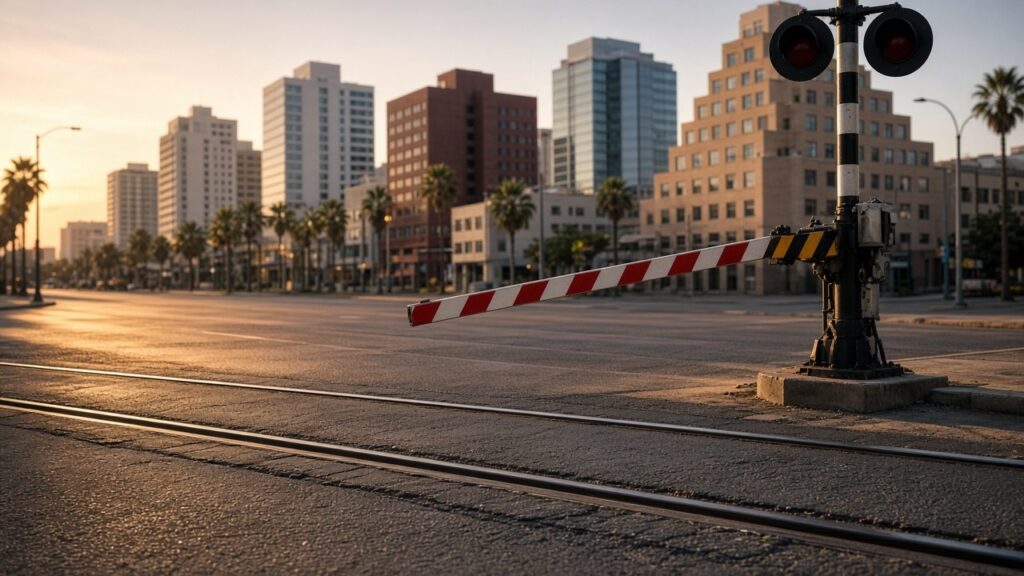
CBS 8 reported on November 17, 2026 that a Waymo driverless vehicle got stuck on trolley tracks Monday night, November 16, at the County Center/Little Italy trolley station in San Diego. According to that report, the vehicle stopped on the tracks as a trolley approached, then reversed through lowered crossing gates, and its rear window was broken in the process. Police responded, and a Waymo employee later arrived and drove the vehicle away. CBS 8 said Waymo did not respond to a request for comment.
In a statement to CBS 8, the Metropolitan Transit System confirmed the incident and said it is under investigation. MTS said it is in contact with both Waymo and the California Department of Motor Vehicles. FOX 5 San Diego also reported that a driverless Waymo vehicle entered the tracks in downtown San Diego and reversed through the crossing gate. The coverage described damage to the vehicle and did not report injuries. Accounts differ on other details, and we do not repeat those conflicts here.
The reports describe the vehicle and the crossing gate. They do not describe a collision between the trolley and the car, and we do not invent one. This article does not assign fault to Waymo, MTS, or anyone else. An investigation is not a finding. CBS 8 also noted that the incident came after the California DMV restricted Waymo from freeway operations beginning November 11, 2026, following other incidents. That freeway restriction is separate from this crossing, and it is not a finding about what happened at the station. For what the California DMV’s November 11, 2026 freeway restriction means if a robotaxi hits you, see our article Waymo Pulled Off California Freeways: What the DMV Order Means If a Robotaxi Hits You.
Who could be liable
Responsibility after a crash involving a robotaxi and a public trolley depends on the facts, not on the type of vehicle alone. The same framework would apply if someone is hurt at a crossing that involves a driverless car and the San Diego Trolley.
- The autonomous vehicle operator. With no human driver, a claim often focuses on the company that put the vehicle on the road, here reported as Waymo, and on that company’s insurance or self-insurance. California’s general negligence rule, Civil Code section 1714, makes a person or company responsible for injuries caused by a lack of ordinary care. Civil Code section 2100 requires a carrier of persons for reward to use the utmost care and diligence for their safe carriage. Whether and how that statute applies to a driverless ride is an open question, which our guide to Waymo’s California expansion and the rules if you are hurt discusses. Nothing in the news reports decides that question for this incident.
- MTS as a public entity. The San Diego Trolley is operated in connection with the Metropolitan Transit System. If a person was hurt and the facts later show that the transit agency or a related public entity may share responsibility, a government claim may be required. That is a separate track from a claim against a private company. Our government claims page and our MTS and San Diego Trolley accident page explain that process. Our article on who investigates a San Diego trolley crash covers the roles of police, MTS, and the California Public Utilities Commission, including records that can matter later. For local context, see our San Diego injury page.
- CPUC rail-crossing and transit safety rules. The CPUC oversees rail transit safety in California and reviews agency investigations. It also has a role in rail crossing safety. Those rules can shape what records exist. They do not, by themselves, decide who pays after a particular incident, and they do not extend claim deadlines.
- Other parties and shared fault. California uses pure comparative fault. Depending on the evidence, more than one party may share responsibility. A crash report or an open investigation does not, by itself, prove fault.
The six-month deadline for a claim against MTS
Before you can sue a California public entity for personal injury, you generally must present a written claim within six months of the injury, under Government Code section 911.2. If a claim against MTS may be involved, that six-month clock matters even while an investigation continues. An investigation does not pause the deadline. If the agency rejects the claim in writing, section 945.6 generally gives six months from that notice to file suit. If the six-month claim deadline is missed, an application for leave to present a late claim under section 911.4 must be made within a reasonable time, and no later than one year after the injury. Use the earliest date until a lawyer confirms which rules apply.
Most injury lawsuits against private parties, including a private autonomous vehicle operator, must be filed within two years under Code of Civil Procedure section 335.1. Rider terms for a robotaxi account may also set their own notice or arbitration steps, so those should be checked early.
What a robotaxi passenger’s own insurance may cover
If you are hurt as a passenger in a robotaxi, the operator’s insurance or self-insurance is often the first place to look. Your own auto policy can still matter. Medical payments coverage, if you have it, may help pay medical bills regardless of fault. Uninsured or underinsured motorist coverage can matter if another vehicle was involved and that insurance is missing or too low, or in some cases when coverage questions arise. Health insurance may also pay in the short term. None of that depends on a finding about this particular incident, and policy language controls. Keep your declarations page and any notices you receive from the company or its insurer.
Evidence to preserve
Video, sensor files, and crossing footage can be overwritten under routine retention schedules. If you were hurt, or if a family member was, it can help to save:
- Photographs of the scene, the vehicle, the crossing gate, and any damage, without relying on news video alone.
- The police report number and any later crash report.
- A written request that the autonomous vehicle company preserve sensor data, cameras, and logs. A lawyer can send this.
- A written request that MTS preserve trolley video, station cameras, and crossing records. A Public Records Act request alone does not preserve video.
- Any trip receipt, trip identifier, and in-app messages, if you were a rider.
- Names of witnesses and nearby cameras.
- Medical records and bills.
- Regulatory filings, if any, including reports to the DMV or the National Highway Traffic Safety Administration, when they become available.
You are not required to give a recorded statement to the other side, and you should not sign a release without legal advice.
Talk to us
Win Attorneys handles robotaxi, trolley, and other injury claims throughout California from our only office at 17291 Irvine Blvd., Suite 210, Tustin, CA 92780. We speak Spanish and Vietnamese.
Call us at (657) 235-8097, reach us through our contact page, or start online with our intake form.
This article is general information and is not legal advice. Reading it does not create an attorney-client relationship. It does not decide fault in the November 16, 2026 incident at the County Center/Little Italy station, and it does not report any official finding.
Sources
- CBS 8, “Waymo driverless vehicle gets stuck on San Diego trolley tracks,” November 17, 2026.
- FOX 5 San Diego, November 17, 2026.
- Civil Code section 1714, section 2100, Code of Civil Procedure section 335.1, Government Code section 911.2, section 911.4, and section 945.6.
Frequently asked questions
Who pays if a driverless car is hit on San Diego trolley tracks?
It depends on the facts. The autonomous vehicle operator and its insurance, a public entity such as MTS, or more than one party may be involved. California uses comparative fault. News reports about the November 16, 2026 incident do not decide fault, and no official findings have been released.
Do I have six months to file a claim with MTS?
A written claim against a California public entity for personal injury generally must be presented within six months under Government Code section 911.2. An open investigation does not extend that deadline. Most private injury lawsuits must be filed within two years.
If I am a passenger in a robotaxi, does my own insurance matter?
Yes, it can. The operator’s insurance or self-insurance is often the first place to look, but medical payments coverage and uninsured or underinsured motorist coverage on your own auto policy, and health insurance, may also apply. Policy language controls.
What evidence should be preserved after a crossing incident?
Ask the autonomous vehicle company, in writing, to keep sensor data, cameras, and logs. Ask MTS, in writing, to keep trolley and station video and crossing records. Also save photographs, the police report number, trip records if you were a rider, witness names, medical bills, and any later DMV or NHTSA filings.
Does a CPUC or DMV investigation decide who pays?
No. Those investigations can produce records that matter later, but they do not by themselves decide civil liability or extend the six-month government claim deadline.
Do your lawyers speak Spanish or Vietnamese?
Yes. We speak Spanish and Vietnamese, and we help people statewide from our only office at 17291 Irvine Blvd., Suite 210, Tustin, CA 92780.