
Last updated
By Ron McMinn, Esq. | Official sources checked November 12, 2026.
Read this article in Español.
Shipt, Instacart, DoorDash, Uber Eats and other food and grocery delivery drivers are on California roads at every hour. When one is involved in a crash, the first question is usually whose insurance applies. The answer can depend on what the app showed at the moment of the crash, whether the driver’s personal policy covers delivery work, and whether the driver is an app-based contractor or an employee. We are not quoting any company’s current policy terms in this article. The statutory rules below apply to delivery network companies as a group.
Short answer: California’s Proposition 22 requires delivery network companies to carry at least $1,000,000 per occurrence in auto liability coverage for injuries or losses to third parties during engaged time, when the vehicle is not otherwise covered by a qualifying policy. It also requires occupational accident insurance for drivers hurt while online. Exact coverage depends on the facts, so the app records matter.
Two different situations
- You were hit by a delivery driver. You are a third party. The driver’s own auto policy, the delivery company’s coverage, or both may be involved.
- You were hurt while delivering. Prop 22’s occupational accident insurance may help with medical bills and lost income, and you may also have a claim against another driver who caused the crash.
What Prop 22 says about insurance
Proposition 22 is codified in the Business and Professions Code starting at section 7448. Under section 7455:
- Drivers hurt while online. The company must provide occupational accident insurance covering medical expenses of at least $1,000,000, plus disability payments equal to 66 percent of the driver’s average weekly earnings for up to 104 weeks. The statute defines “online” for this purpose.
- Deaths. The company must also provide accidental death insurance for drivers who die while online.
- Third parties hit by a delivery driver. A delivery network company must maintain automobile liability insurance of at least $1,000,000 per occurrence to compensate third parties for injuries or losses during engaged time, when the vehicle is not otherwise covered by a policy that meets Insurance Code section 11580.1(b).
- Rideshare is different. Companies carrying passengers follow the Public Utilities Code rules for transportation network companies. See whose insurance pays in an Uber or Lyft crash.
Section 7463 defines “engaged time” for delivery as the period from when the driver accepts a delivery request to when the driver completes it, not counting requests that are cancelled or abandoned.
We are not quoting any company’s current policy terms in this article. Companies may buy more coverage than the statute requires, and the policy that actually applies should be confirmed from the documents.
Why app status matters
Whether the driver had accepted an order, was on the way, or had just finished can change which coverage applies. Useful proof includes:
- Screenshots of the driver’s app, order receipts, and delivery time stamps.
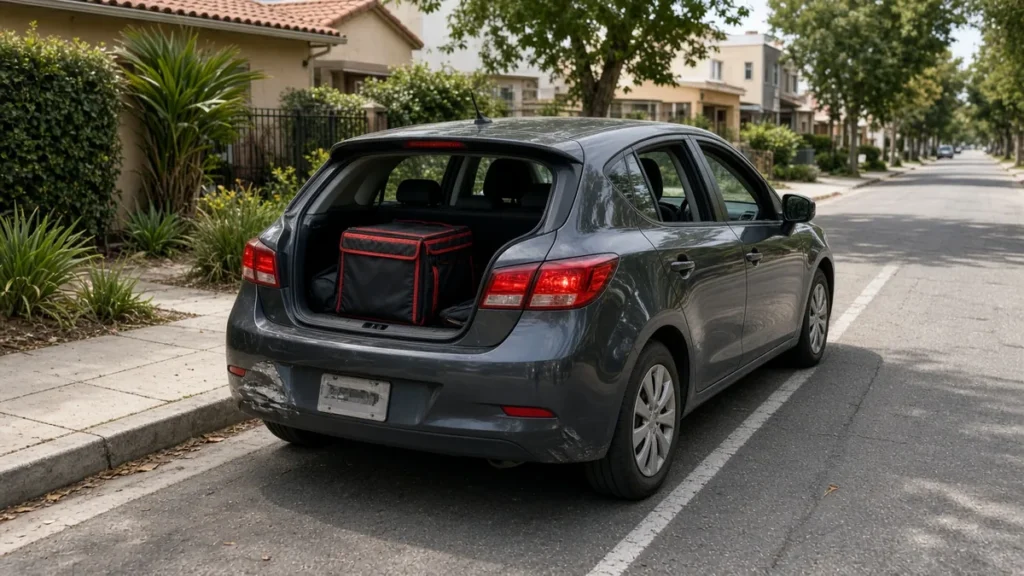
- Photos of any delivery bags, signs, or packages in the car.
- The police report and both drivers’ insurance information.
Many personal auto policies limit coverage when a car is used to deliver for pay, so the driver’s own insurer may question the claim. That is one reason the company’s coverage, and your own uninsured and underinsured motorist coverage, can become important.
Not every delivery driver is an app contractor
Some delivery drivers are employees of a delivery business rather than app-based contractors. When an employee causes a crash while working, the employer can be responsible, and an employee hurt on the job usually looks to workers’ compensation. Ask who the driver worked for before assuming Prop 22 controls.
Deadlines
Most injury lawsuits must be filed within two years under Code of Civil Procedure section 335.1. If a public vehicle or road defect is involved, a claim is usually due within six months under Government Code section 911.2.
See our rideshare and delivery accidents page and the SB 371 rideshare UM and UIM change.
Talk to us
Win Attorneys handles personal injury and government claims matters statewide from our only office in Tustin. We speak Spanish and Vietnamese.
Call us at (657) 235-8097, write through our contact page, or start online with our intake form. Office: 17291 Irvine Blvd., Suite 210, Tustin, CA 92780.
Sources
- Business and Professions Code section 7455 and section 7463 (Proposition 22).
- Insurance Code section 11580.1.
- Code of Civil Procedure section 335.1; Government Code section 911.2.
Frequently asked questions
Who pays if a delivery driver hits me in California?
It depends on the facts. The driver’s own auto policy may apply, and under Business and Professions Code section 7455 a delivery network company must carry at least $1,000,000 per occurrence for third party injuries during engaged time when the vehicle is not otherwise covered by a qualifying policy.
What is engaged time?
Under Business and Professions Code section 7463, engaged time for delivery runs from when the driver accepts a delivery request to when the driver completes it, not counting requests that are cancelled or abandoned.
I was hurt while delivering. Is there insurance for me?
Prop 22 requires occupational accident insurance for drivers hurt while online, covering medical expenses of at least $1,000,000, plus disability payments of 66 percent of average weekly earnings for up to 104 weeks.
Can I still sue the other driver if I was hurt while delivering?
Often, yes. If another driver caused the crash, you may have an injury claim against that driver in addition to any occupational accident benefits.
Does the driver’s personal insurance cover delivery work?
Not always. Many personal auto policies limit coverage when a car is used to deliver for pay. The actual policy language decides it.
How long do I have to file a claim?
Most injury lawsuits must be filed within two years. Claims against a public entity usually must be presented within six months.
Does this apply if the driver was working for Shipt, Instacart, DoorDash or Uber Eats?
The Prop 22 insurance rules discussed in this article apply to delivery network companies as a group, including app-based grocery and food delivery. We are not quoting any company’s current policy terms. Confirm the app, the driver’s status at the time of the crash, and the actual policy documents.
Can I talk to a lawyer in Spanish or Vietnamese?
Yes. We speak Spanish and Vietnamese. Call (657) 235-8097. Our only office is at 17291 Irvine Blvd., Suite 210, Tustin, CA 92780.
This article is general information and is not legal advice. Reading it does not create an attorney-client relationship. Every case depends on its own facts.